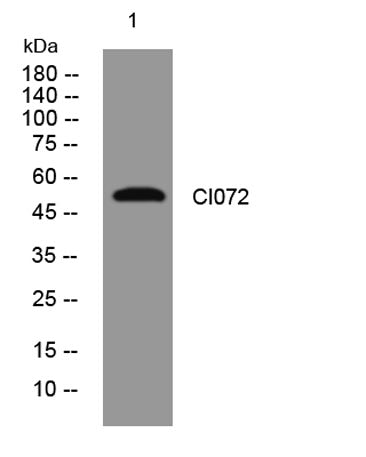
1
/
of
1
ELK Biotechnology
SKU:ES17460
CI072 rabbit pAb
CI072 rabbit pAb
Regular price
$250.00 USD
Regular price
Sale price
$250.00 USD
Unit price
/
per
Shipping calculated at checkout.
Couldn't load pickup availability
Applications: WB
Reactivity: Human; Mouse;Rat
Source: Rabbit
Dilution: WB 1:500-2000
Immunogen: Synthesized peptide derived from human CI072 AA range: 188-238
Storage_stability: -20°C/1 year
Clonality: Polyclonal
Isotype: IgG
Concentration: 1 mg/ml
Human_gene_id: 203228
Human_swiss_prot_no: Q96LT7
Subcellular_location: Nucleus . Cytoplasm . Cytoplasm, P-body . Cytoplasm, Stress granule . Endosome . Lysosome . Cytoplasmic vesicle, autophagosome . Secreted . Cell projection, axon . Cell projection, growth cone . Perikaryon . Detected in the cytoplasm of neurons from brain tissue (PubMed:21944778). Detected in the nucleus in fibroblasts (PubMed:21944779). During corticogenesis, transitions from being predominantly cytoplasmic to a more even nucleocytoplasmic distribution (By similarity). .; [Isoform 1]: Perikaryon . Cell projection, dendrite . Cell junction, synapse, presynapse . Cell junction, synapse, postsynapse . Expressed diffusely throughout the cytoplasm and dendritic processes of cerebellar Purkinje cells. Also expressed diffusely throughout the cytoplasm of spinal motor neurons. .; [Isoform 2]: Nuc
Background: The protein encoded by this gene plays an important role in the regulation of endosomal trafficking, and has been shown to interact with Rab proteins that are involved in autophagy and endocytic transport. Expansion of a GGGGCC repeat from 2-22 copies to 700-1600 copies in the intronic sequence between alternate 5' exons in transcripts from this gene is associated with 9p-linked ALS (amyotrophic lateral sclerosis) and FTD (frontotemporal dementia) (PMID: 21944778, 21944779). Studies suggest that hexanucleotide expansions could result in the selective stabilization of repeat-containing pre-mRNA, and the accumulation of insoluble dipeptide repeat protein aggregates that could be pathogenic in FTD-ALS patients (PMID: 23393093). Alternative splicing results in multiple transcript variants encoding different isoforms. [provided by RefSeq, Jul 2016],
Reactivity: Human; Mouse;Rat
Source: Rabbit
Dilution: WB 1:500-2000
Immunogen: Synthesized peptide derived from human CI072 AA range: 188-238
Storage_stability: -20°C/1 year
Clonality: Polyclonal
Isotype: IgG
Concentration: 1 mg/ml
Human_gene_id: 203228
Human_swiss_prot_no: Q96LT7
Subcellular_location: Nucleus . Cytoplasm . Cytoplasm, P-body . Cytoplasm, Stress granule . Endosome . Lysosome . Cytoplasmic vesicle, autophagosome . Secreted . Cell projection, axon . Cell projection, growth cone . Perikaryon . Detected in the cytoplasm of neurons from brain tissue (PubMed:21944778). Detected in the nucleus in fibroblasts (PubMed:21944779). During corticogenesis, transitions from being predominantly cytoplasmic to a more even nucleocytoplasmic distribution (By similarity). .; [Isoform 1]: Perikaryon . Cell projection, dendrite . Cell junction, synapse, presynapse . Cell junction, synapse, postsynapse . Expressed diffusely throughout the cytoplasm and dendritic processes of cerebellar Purkinje cells. Also expressed diffusely throughout the cytoplasm of spinal motor neurons. .; [Isoform 2]: Nuc
Background: The protein encoded by this gene plays an important role in the regulation of endosomal trafficking, and has been shown to interact with Rab proteins that are involved in autophagy and endocytic transport. Expansion of a GGGGCC repeat from 2-22 copies to 700-1600 copies in the intronic sequence between alternate 5' exons in transcripts from this gene is associated with 9p-linked ALS (amyotrophic lateral sclerosis) and FTD (frontotemporal dementia) (PMID: 21944778, 21944779). Studies suggest that hexanucleotide expansions could result in the selective stabilization of repeat-containing pre-mRNA, and the accumulation of insoluble dipeptide repeat protein aggregates that could be pathogenic in FTD-ALS patients (PMID: 23393093). Alternative splicing results in multiple transcript variants encoding different isoforms. [provided by RefSeq, Jul 2016],
Share