1
/
of
1
ELK Biotechnology
SKU:ES17335
COLA1 rabbit pAb
COLA1 rabbit pAb
Regular price
$250.00 USD
Regular price
Sale price
$250.00 USD
Unit price
/
per
Shipping calculated at checkout.
Couldn't load pickup availability
Applications: WB
Reactivity: Human;Rat;Mouse;
Source: Rabbit
Dilution: WB 1:500-2000
Immunogen: Synthesized peptide derived from human COLA1 AA range: 101-151
Storage_stability: -20°C/1 year
Clonality: Polyclonal
Isotype: IgG
Concentration: 1 mg/ml
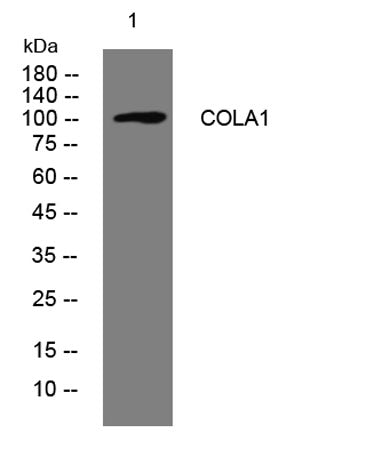
Observed_band(KD): 105kD
Human_gene_id: 81578
Human_swiss_prot_no: Q96P44
Subcellular_location: Secreted, extracellular space, extracellular matrix . Cytoplasm . Found in the extracellular matrix component of blood vessel walls and in the cytoplasm of cultured human aortic smooth muscle.
Other_name: Collagen alpha-1(XXI) chain
Background: This gene encodes the alpha chain of type XXI collagen, a member of the FACIT (fibril-associated collagens with interrupted helices) collagen family. Type XXI collagen is localized to tissues containing type I collagen and maintains the integrity of the extracellular matrix. Alternative splicing results in multiple transcript variants. [provided by RefSeq, Jan 2016],
Reactivity: Human;Rat;Mouse;
Source: Rabbit
Dilution: WB 1:500-2000
Immunogen: Synthesized peptide derived from human COLA1 AA range: 101-151
Storage_stability: -20°C/1 year
Clonality: Polyclonal
Isotype: IgG
Concentration: 1 mg/ml
Observed_band(KD): 105kD
Human_gene_id: 81578
Human_swiss_prot_no: Q96P44
Subcellular_location: Secreted, extracellular space, extracellular matrix . Cytoplasm . Found in the extracellular matrix component of blood vessel walls and in the cytoplasm of cultured human aortic smooth muscle.
Other_name: Collagen alpha-1(XXI) chain
Background: This gene encodes the alpha chain of type XXI collagen, a member of the FACIT (fibril-associated collagens with interrupted helices) collagen family. Type XXI collagen is localized to tissues containing type I collagen and maintains the integrity of the extracellular matrix. Alternative splicing results in multiple transcript variants. [provided by RefSeq, Jan 2016],
Share