1
/
of
1
ELK Biotechnology
SKU:ES16679
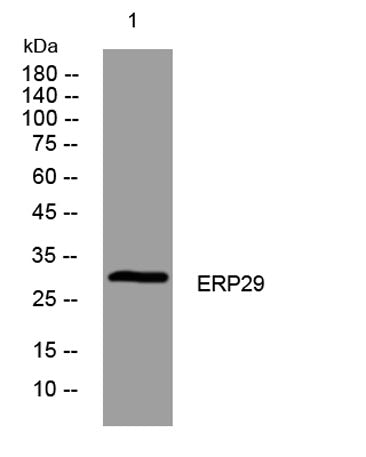
ERP29 rabbit pAb
ERP29 rabbit pAb
Regular price
$250.00 USD
Regular price
Sale price
$250.00 USD
Unit price
/
per
Shipping calculated at checkout.
Couldn't load pickup availability
Applications: WB
Reactivity: Human; Mouse;Rat
Source: Rabbit
Dilution: WB 1:500-2000
Immunogen: Synthesized peptide derived from human ERP29 AA range: 141-191
Storage_stability: -20°C/1 year
Clonality: Polyclonal
Isotype: IgG
Concentration: 1 mg/ml
Human_gene_id: 10961
Human_swiss_prot_no: P30040
Subcellular_location: Endoplasmic reticulum lumen. Melanosome. Identified by mass spectrometry in melanosome fractions from stage I to stage IV.
Background: This gene encodes a reticuloplasmin, a protein which resides in the lumen of the endoplasmic reticulum (ER). The protein shows sequence similarity to the protein disulfide isomerase family. However, it lacks the thioredoxin motif characteristic of this family, suggesting that this protein does not function as a disulfide isomerase. The protein dimerizes and is thought to play a role in the processing of secretory proteins within the ER. Alternative splicing results in multiple transcript variants encoding different isoforms. [provided by RefSeq, Jul 2008],
Reactivity: Human; Mouse;Rat
Source: Rabbit
Dilution: WB 1:500-2000
Immunogen: Synthesized peptide derived from human ERP29 AA range: 141-191
Storage_stability: -20°C/1 year
Clonality: Polyclonal
Isotype: IgG
Concentration: 1 mg/ml
Human_gene_id: 10961
Human_swiss_prot_no: P30040
Subcellular_location: Endoplasmic reticulum lumen. Melanosome. Identified by mass spectrometry in melanosome fractions from stage I to stage IV.
Background: This gene encodes a reticuloplasmin, a protein which resides in the lumen of the endoplasmic reticulum (ER). The protein shows sequence similarity to the protein disulfide isomerase family. However, it lacks the thioredoxin motif characteristic of this family, suggesting that this protein does not function as a disulfide isomerase. The protein dimerizes and is thought to play a role in the processing of secretory proteins within the ER. Alternative splicing results in multiple transcript variants encoding different isoforms. [provided by RefSeq, Jul 2008],
Share