1
/
of
1
ELK Biotechnology
SKU:ES16662
ESX1 rabbit pAb
ESX1 rabbit pAb
Regular price
$250.00 USD
Regular price
Sale price
$250.00 USD
Unit price
/
per
Shipping calculated at checkout.
Couldn't load pickup availability
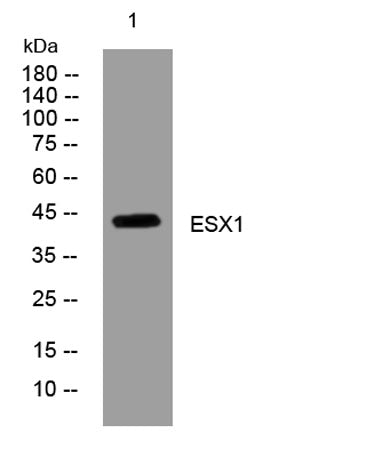
Applications: WB
Reactivity: Human;Rat;Mouse;
Source: Rabbit
Dilution: WB 1:500-2000
Immunogen: Synthesized peptide derived from human ESX1 AA range: 327-377
Storage_stability: -20°C/1 year
Clonality: Polyclonal
Isotype: IgG
Concentration: 1 mg/ml
Human_gene_id: 80712
Human_swiss_prot_no: Q8N693
Subcellular_location: Cytoplasm . Nucleus . ESXR1-N localizes specifically to the nucleus while ESXR1-C localizes specifically to the cytoplasm.
Background: This gene encodes a dual-function 65 kDa protein that undergoes proteolytic cleavage to produce a 45 kDa N-terminal fragment with a paired-like homeodomain and a 20 kDa C-terminal fragment with a proline-rich domain. The C-terminal fragment localizes to the cytoplasm while the N-terminal fragment localizes exclusively to the nucleus. In contrast to human, the mouse homolog has a novel PN/PF motif in the C-terminus and is paternally imprinted in placental tissue. This gene likely plays a role in placental development and spermatogenesis. [provided by RefSeq, Jan 2010],
Reactivity: Human;Rat;Mouse;
Source: Rabbit
Dilution: WB 1:500-2000
Immunogen: Synthesized peptide derived from human ESX1 AA range: 327-377
Storage_stability: -20°C/1 year
Clonality: Polyclonal
Isotype: IgG
Concentration: 1 mg/ml
Human_gene_id: 80712
Human_swiss_prot_no: Q8N693
Subcellular_location: Cytoplasm . Nucleus . ESXR1-N localizes specifically to the nucleus while ESXR1-C localizes specifically to the cytoplasm.
Background: This gene encodes a dual-function 65 kDa protein that undergoes proteolytic cleavage to produce a 45 kDa N-terminal fragment with a paired-like homeodomain and a 20 kDa C-terminal fragment with a proline-rich domain. The C-terminal fragment localizes to the cytoplasm while the N-terminal fragment localizes exclusively to the nucleus. In contrast to human, the mouse homolog has a novel PN/PF motif in the C-terminus and is paternally imprinted in placental tissue. This gene likely plays a role in placental development and spermatogenesis. [provided by RefSeq, Jan 2010],
Share