1
/
of
1
ELK Biotechnology
SKU:ES16473
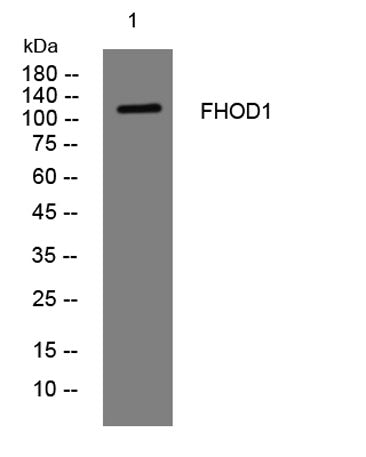
FHOD1 rabbit pAb
FHOD1 rabbit pAb
Regular price
$250.00 USD
Regular price
Sale price
$250.00 USD
Unit price
/
per
Shipping calculated at checkout.
Couldn't load pickup availability
Applications: WB
Reactivity: Human; Mouse
Source: Rabbit
Dilution: WB 1:500-2000
Immunogen: Synthesized peptide derived from human FHOD1 AA range: 210-260
Storage_stability: -20°C/1 year
Clonality: Polyclonal
Isotype: IgG
Concentration: 1 mg/ml
Human_gene_id: 29109
Human_swiss_prot_no: Q9Y613
Subcellular_location: Cytoplasm. Cytoplasm, cytoskeleton. Cell projection, bleb. Predominantly cytoplasmic.
Background: This gene encodes a protein which is a member of the formin/diaphanous family of proteins. The gene is ubiquitously expressed but is found in abundance in the spleen. The encoded protein has sequence homology to diaphanous and formin proteins within the Formin Homology (FH)1 and FH2 domains. It also contains a coiled-coil domain, a collagen-like domain, two nuclear localization signals, and several potential PKC and PKA phosphorylation sites. It is a predominantly cytoplasmic protein and is expressed in a variety of human cell lines. Alternative splicing results in multiple transcript variants. [provided by RefSeq, Dec 2015],
Reactivity: Human; Mouse
Source: Rabbit
Dilution: WB 1:500-2000
Immunogen: Synthesized peptide derived from human FHOD1 AA range: 210-260
Storage_stability: -20°C/1 year
Clonality: Polyclonal
Isotype: IgG
Concentration: 1 mg/ml
Human_gene_id: 29109
Human_swiss_prot_no: Q9Y613
Subcellular_location: Cytoplasm. Cytoplasm, cytoskeleton. Cell projection, bleb. Predominantly cytoplasmic.
Background: This gene encodes a protein which is a member of the formin/diaphanous family of proteins. The gene is ubiquitously expressed but is found in abundance in the spleen. The encoded protein has sequence homology to diaphanous and formin proteins within the Formin Homology (FH)1 and FH2 domains. It also contains a coiled-coil domain, a collagen-like domain, two nuclear localization signals, and several potential PKC and PKA phosphorylation sites. It is a predominantly cytoplasmic protein and is expressed in a variety of human cell lines. Alternative splicing results in multiple transcript variants. [provided by RefSeq, Dec 2015],
Share