1
/
of
1
ELK Biotechnology
SKU:ES1623
AKAP 95 rabbit pAb
AKAP 95 rabbit pAb
Regular price
$250.00 USD
Regular price
Sale price
$250.00 USD
Unit price
/
per
Shipping calculated at checkout.
Couldn't load pickup availability
Applications: WB;IHC;IF;ELISA
Reactivity: Human;Mouse;Rat
Source: Rabbit
Dilution: Western Blot: 1/500 - 1/2000. Immunohistochemistry: 1/100 - 1/300. Immunofluorescence: 1/200 - 1/1000. ELISA: 1/20000. Not yet tested in other applications.
Immunogen: The antiserum was produced against synthesized peptide derived from human AKAP8. AA range:331-380
Storage_stability: -20°C/1 year
Clonality: Polyclonal
Isotype: IgG
Concentration: 1 mg/ml
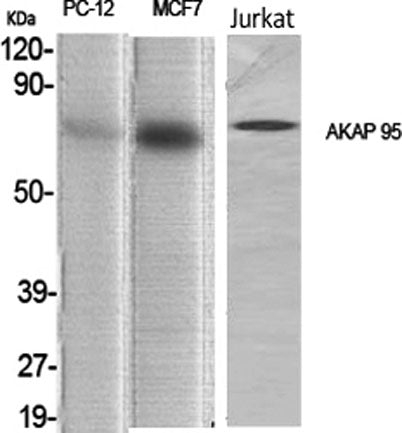
Observed_band(KD): 76kD
Human_gene_id: 10270
Human_swiss_prot_no: O43823
Subcellular_location: Nucleus . Nucleus matrix . Nucleus, nucleolus . Cytoplasm . Associated with the nuclear matrix in interphase and redistributes mostly to chromatin at mitosis. However, mitotic chromatin localization has been questioned. Upon nuclear reassembly at the end of mitosis, is sequestered into the daughter nuclei where it re-acquires an interphase distribution. Exhibits partial localization to the nucleolus in interphase, where it colocalizes with UBTF/UBF, suggesting localization to the fibrillary center and/or to the dense fibrillary component. Colocalizes with GJA1 at the nuclear membrane specifically during cell cycle G1/S phase. .
Other_name: AKAP8; AKAP95; A-kinase anchor protein 8; AKAP-8; A-kinase anchor protein 95 kDa; AKAP 95
Background: This gene encodes a member of the A-kinase anchor protein family. A-kinase anchor proteins are scaffold proteins that contain a binding domain for the RI/RII subunit of protein kinase A (PKA) and recruit PKA and other signaling molecules to specific subcellular locations. This gene encodes a nuclear A-kinase anchor protein that binds to the RII alpha subunit of PKA and may play a role in chromosome condensation during mitosis by targeting PKA and the condensin complex to chromatin. A pseudogene of this gene is located on the short arm of chromosome 9. [provided by RefSeq, May 2011],
Reactivity: Human;Mouse;Rat
Source: Rabbit
Dilution: Western Blot: 1/500 - 1/2000. Immunohistochemistry: 1/100 - 1/300. Immunofluorescence: 1/200 - 1/1000. ELISA: 1/20000. Not yet tested in other applications.
Immunogen: The antiserum was produced against synthesized peptide derived from human AKAP8. AA range:331-380
Storage_stability: -20°C/1 year
Clonality: Polyclonal
Isotype: IgG
Concentration: 1 mg/ml
Observed_band(KD): 76kD
Human_gene_id: 10270
Human_swiss_prot_no: O43823
Subcellular_location: Nucleus . Nucleus matrix . Nucleus, nucleolus . Cytoplasm . Associated with the nuclear matrix in interphase and redistributes mostly to chromatin at mitosis. However, mitotic chromatin localization has been questioned. Upon nuclear reassembly at the end of mitosis, is sequestered into the daughter nuclei where it re-acquires an interphase distribution. Exhibits partial localization to the nucleolus in interphase, where it colocalizes with UBTF/UBF, suggesting localization to the fibrillary center and/or to the dense fibrillary component. Colocalizes with GJA1 at the nuclear membrane specifically during cell cycle G1/S phase. .
Other_name: AKAP8; AKAP95; A-kinase anchor protein 8; AKAP-8; A-kinase anchor protein 95 kDa; AKAP 95
Background: This gene encodes a member of the A-kinase anchor protein family. A-kinase anchor proteins are scaffold proteins that contain a binding domain for the RI/RII subunit of protein kinase A (PKA) and recruit PKA and other signaling molecules to specific subcellular locations. This gene encodes a nuclear A-kinase anchor protein that binds to the RII alpha subunit of PKA and may play a role in chromosome condensation during mitosis by targeting PKA and the condensin complex to chromatin. A pseudogene of this gene is located on the short arm of chromosome 9. [provided by RefSeq, May 2011],
Share