1
/
of
1
ELK Biotechnology
SKU:ES1575
Abi-1 rabbit pAb
Abi-1 rabbit pAb
Regular price
$250.00 USD
Regular price
Sale price
$250.00 USD
Unit price
/
per
Shipping calculated at checkout.
Couldn't load pickup availability
Applications: WB;ELISA
Reactivity: Human;Mouse;Rat
Source: Rabbit
Dilution: Western Blot: 1/500 - 1/2000. ELISA: 1/40000. Not yet tested in other applications.
Immunogen: The antiserum was produced against synthesized peptide derived from human Abi-1. AA range:152-201
Storage_stability: -20°C/1 year
Clonality: Polyclonal
Isotype: IgG
Concentration: 1 mg/ml
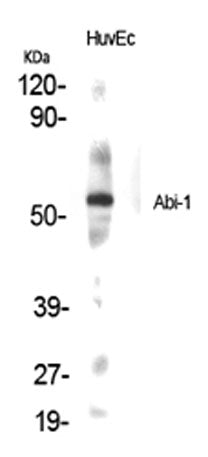
Observed_band(KD): 55kD
Human_gene_id: 10006
Human_swiss_prot_no: Q8IZP0
Subcellular_location: Cytoplasm . Nucleus . Cell projection, lamellipodium . Cell projection, filopodium . Cell projection, growth cone . Cell junction, synapse, postsynaptic density . Cytoplasm, cytoskeleton . Localized to protruding lamellipodia and filopodia tips. Also localized to neuronal growth cones and synaptosomes. May shuttle from the postsynaptic densities to the nucleus (By similarity). .
Other_name: ABI1; SSH3BP1; Abl interactor 1; Abelson interactor 1; Abi-1; Abl-binding protein 4; AblBP4; Eps8 SH3 domain-binding protein; Eps8-binding protein; Nap1-binding protein; Nap1BP; Spectrin SH3 domain-binding protein 1; e3B1
Background: This gene encodes a member of the Abelson-interactor family of adaptor proteins. These proteins facilitate signal transduction as components of several multiprotein complexes, and regulate actin polymerization and cytoskeletal remodeling through interactions with Abelson tyrosine kinases. The encoded protein plays a role in macropinocytosis as a component of the WAVE2 complex, and also forms a complex with EPS8 and SOS1 that mediates signal transduction from Ras to Rac. This gene may play a role in the progression of several malignancies including melanoma, colon cancer and breast cancer, and a t(10;11) chromosomal translocation involving this gene and the MLL gene has been associated with acute myeloid leukemia. Alternatively spliced transcript variants encoding multiple isoforms have been observed for this gene, and a pseudogene of this gene is located on the long arm of chromosome 14. [provided by RefSeq
Reactivity: Human;Mouse;Rat
Source: Rabbit
Dilution: Western Blot: 1/500 - 1/2000. ELISA: 1/40000. Not yet tested in other applications.
Immunogen: The antiserum was produced against synthesized peptide derived from human Abi-1. AA range:152-201
Storage_stability: -20°C/1 year
Clonality: Polyclonal
Isotype: IgG
Concentration: 1 mg/ml
Observed_band(KD): 55kD
Human_gene_id: 10006
Human_swiss_prot_no: Q8IZP0
Subcellular_location: Cytoplasm . Nucleus . Cell projection, lamellipodium . Cell projection, filopodium . Cell projection, growth cone . Cell junction, synapse, postsynaptic density . Cytoplasm, cytoskeleton . Localized to protruding lamellipodia and filopodia tips. Also localized to neuronal growth cones and synaptosomes. May shuttle from the postsynaptic densities to the nucleus (By similarity). .
Other_name: ABI1; SSH3BP1; Abl interactor 1; Abelson interactor 1; Abi-1; Abl-binding protein 4; AblBP4; Eps8 SH3 domain-binding protein; Eps8-binding protein; Nap1-binding protein; Nap1BP; Spectrin SH3 domain-binding protein 1; e3B1
Background: This gene encodes a member of the Abelson-interactor family of adaptor proteins. These proteins facilitate signal transduction as components of several multiprotein complexes, and regulate actin polymerization and cytoskeletal remodeling through interactions with Abelson tyrosine kinases. The encoded protein plays a role in macropinocytosis as a component of the WAVE2 complex, and also forms a complex with EPS8 and SOS1 that mediates signal transduction from Ras to Rac. This gene may play a role in the progression of several malignancies including melanoma, colon cancer and breast cancer, and a t(10;11) chromosomal translocation involving this gene and the MLL gene has been associated with acute myeloid leukemia. Alternatively spliced transcript variants encoding multiple isoforms have been observed for this gene, and a pseudogene of this gene is located on the long arm of chromosome 14. [provided by RefSeq
Share