1
/
of
1
ELK Biotechnology
SKU:ES15472
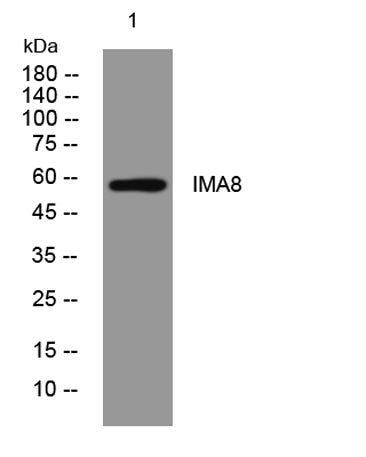
IMA8 rabbit pAb
IMA8 rabbit pAb
Regular price
$250.00 USD
Regular price
Sale price
$250.00 USD
Unit price
/
per
Shipping calculated at checkout.
Couldn't load pickup availability
Applications: WB
Reactivity: Human; Mouse
Source: Rabbit
Dilution: WB 1:500-2000
Immunogen: Synthesized peptide derived from human IMA8 AA range: 313-363
Storage_stability: -20°C/1 year
Clonality: Polyclonal
Isotype: IgG
Concentration: 1 mg/ml
Human_gene_id: 402569
Human_swiss_prot_no: A9QM74
Subcellular_location: Nucleus .
Background: The transport of molecules between the nucleus and the cytoplasm in eukaryotic cells is mediated by the nuclear pore complex (NPC), which consists of 60-100 proteins. Small molecules (up to 70 kD) can pass through the nuclear pore by nonselective diffusion while larger molecules are transported by an active process. The protein encoded by this gene belongs to the importin alpha family, and is involved in nuclear protein import, but exhibits different nuclear localization signal binding specificity compared to other members of the family. A pseudogene of this gene has been defined on chromosome 5. [provided by RefSeq, Jul 2016],
Reactivity: Human; Mouse
Source: Rabbit
Dilution: WB 1:500-2000
Immunogen: Synthesized peptide derived from human IMA8 AA range: 313-363
Storage_stability: -20°C/1 year
Clonality: Polyclonal
Isotype: IgG
Concentration: 1 mg/ml
Human_gene_id: 402569
Human_swiss_prot_no: A9QM74
Subcellular_location: Nucleus .
Background: The transport of molecules between the nucleus and the cytoplasm in eukaryotic cells is mediated by the nuclear pore complex (NPC), which consists of 60-100 proteins. Small molecules (up to 70 kD) can pass through the nuclear pore by nonselective diffusion while larger molecules are transported by an active process. The protein encoded by this gene belongs to the importin alpha family, and is involved in nuclear protein import, but exhibits different nuclear localization signal binding specificity compared to other members of the family. A pseudogene of this gene has been defined on chromosome 5. [provided by RefSeq, Jul 2016],
Share