1
/
of
1
ELK Biotechnology
SKU:ES1449
EphB1/2 (phospho Tyr594/604) rabbit pAb
EphB1/2 (phospho Tyr594/604) rabbit pAb
Regular price
$250.00 USD
Regular price
Sale price
$250.00 USD
Unit price
/
per
Shipping calculated at checkout.
Couldn't load pickup availability
Applications: WB;IF;ELISA
Reactivity: Human;Mouse;Rat
Source: Rabbit
Dilution: Western Blot: 1/500 - 1/2000. Immunofluorescence: 1/200 - 1/1000. ELISA: 1/5000. Not yet tested in other applications.
Immunogen: The antiserum was produced against synthesized peptide derived from human EPHB1/2 around the phosphorylation site of Tyr594/604. AA range:561-610
Storage_stability: -20°C/1 year
Clonality: Polyclonal
Isotype: IgG
Concentration: 1 mg/ml
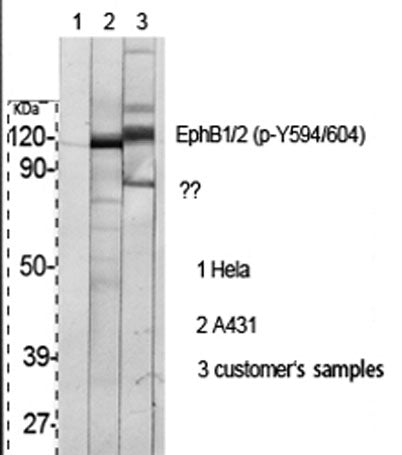
Observed_band(KD): 110kD
Human_gene_id: 2047/1969
Human_swiss_prot_no: P54762/P29323
Subcellular_location: Cell membrane ; Single-pass type I membrane protein . Early endosome membrane . Cell projection, dendrite .
Other_name: EPHB1; ELK; EPHT2; HEK6; NET; Ephrin type-B receptor 1; ELK; EPH tyrosine kinase 2; EPH-like kinase 6; EK6; hEK6; Neuronally-expressed EPH-related tyrosine kinase; NET; Tyrosine-protein kinase receptor EPH-2; EPHB2; DRT; EPHT3; EPTH3; ERK;
Background: Ephrin receptors and their ligands, the ephrins, mediate numerous developmental processes, particularly in the nervous system. Based on their structures and sequence relationships, ephrins are divided into the ephrin-A (EFNA) class, which are anchored to the membrane by a glycosylphosphatidylinositol linkage, and the ephrin-B (EFNB) class, which are transmembrane proteins. The Eph family of receptors are divided into 2 groups based on the similarity of their extracellular domain sequences and their affinities for binding ephrin-A and ephrin-B ligands. Ephrin receptors make up the largest subgroup of the receptor tyrosine kinase (RTK) family. The protein encoded by this gene is a receptor for ephrin-B family members. [provided by RefSeq, Jul 2008],
Reactivity: Human;Mouse;Rat
Source: Rabbit
Dilution: Western Blot: 1/500 - 1/2000. Immunofluorescence: 1/200 - 1/1000. ELISA: 1/5000. Not yet tested in other applications.
Immunogen: The antiserum was produced against synthesized peptide derived from human EPHB1/2 around the phosphorylation site of Tyr594/604. AA range:561-610
Storage_stability: -20°C/1 year
Clonality: Polyclonal
Isotype: IgG
Concentration: 1 mg/ml
Observed_band(KD): 110kD
Human_gene_id: 2047/1969
Human_swiss_prot_no: P54762/P29323
Subcellular_location: Cell membrane ; Single-pass type I membrane protein . Early endosome membrane . Cell projection, dendrite .
Other_name: EPHB1; ELK; EPHT2; HEK6; NET; Ephrin type-B receptor 1; ELK; EPH tyrosine kinase 2; EPH-like kinase 6; EK6; hEK6; Neuronally-expressed EPH-related tyrosine kinase; NET; Tyrosine-protein kinase receptor EPH-2; EPHB2; DRT; EPHT3; EPTH3; ERK;
Background: Ephrin receptors and their ligands, the ephrins, mediate numerous developmental processes, particularly in the nervous system. Based on their structures and sequence relationships, ephrins are divided into the ephrin-A (EFNA) class, which are anchored to the membrane by a glycosylphosphatidylinositol linkage, and the ephrin-B (EFNB) class, which are transmembrane proteins. The Eph family of receptors are divided into 2 groups based on the similarity of their extracellular domain sequences and their affinities for binding ephrin-A and ephrin-B ligands. Ephrin receptors make up the largest subgroup of the receptor tyrosine kinase (RTK) family. The protein encoded by this gene is a receptor for ephrin-B family members. [provided by RefSeq, Jul 2008],
Share