1
/
of
1
ELK Biotechnology
SKU:ES14488
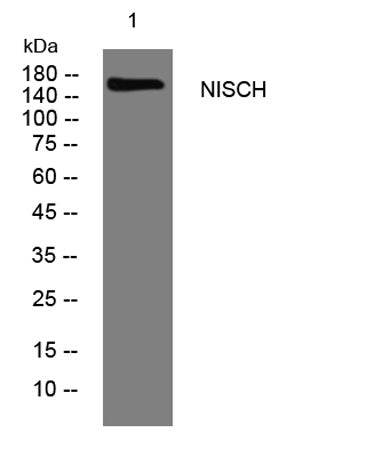
NISCH rabbit pAb
NISCH rabbit pAb
Regular price
$250.00 USD
Regular price
Sale price
$250.00 USD
Unit price
/
per
Shipping calculated at checkout.
Couldn't load pickup availability
Applications: WB
Reactivity: Human; Mouse;Rat
Source: Rabbit
Dilution: WB 1:500-2000
Immunogen: Synthesized peptide derived from human NISCH AA range: 234-284
Storage_stability: -20°C/1 year
Clonality: Polyclonal
Isotype: IgG
Concentration: 1 mg/ml
Human_gene_id: 11188
Human_swiss_prot_no: Q9Y2I1
Subcellular_location: Cell membrane. Cytoplasm. Early endosome. Recycling endosome. Enriched in the early/sorting and recycling endosomes. Colocalized in early/sorting endosomes with EEA1 and SNX2 and in recycling endosomes with transferrin receptor. Detected in the perinuclear region partially associated with punctate structures (By similarity). Colocalizes with PAK1 in cytoplasm, vesicular structures in the perinuclear area and membrane ruffles (By similarity). Colocalizes with RAC1 in the cytoplasm and vesicles structures (By similarity). Colocalized with MAPK1 and MAPK3 in RVLM neurons (By similarity). .
Background: This gene encodes a nonadrenergic imidazoline-1 receptor protein that localizes to the cytosol and anchors to the inner layer of the plasma membrane. The orthologous mouse protein has been shown to influence cytoskeletal organization and cell migration by binding to alpha-5-beta-1 integrin. In humans, this protein has been shown to bind to the adapter insulin receptor substrate 4 (IRS4) to mediate translocation of alpha-5 integrin from the cell membrane to endosomes. Expression of this protein was reduced in human breast cancers while its overexpression reduced tumor growth and metastasis; possibly by limiting the expression of alpha-5 integrin. In human cardiac tissue, this gene was found to affect cell growth and death while in neural tissue it affected neuronal growth and differentiation. Alternative splicing results in multiple transcript variants encoding differerent isoforms. Some isoforms lack the expected C-terminal domains of a functional imidazoline receptor. [provided by RefSeq, Jan 2013],
Reactivity: Human; Mouse;Rat
Source: Rabbit
Dilution: WB 1:500-2000
Immunogen: Synthesized peptide derived from human NISCH AA range: 234-284
Storage_stability: -20°C/1 year
Clonality: Polyclonal
Isotype: IgG
Concentration: 1 mg/ml
Human_gene_id: 11188
Human_swiss_prot_no: Q9Y2I1
Subcellular_location: Cell membrane. Cytoplasm. Early endosome. Recycling endosome. Enriched in the early/sorting and recycling endosomes. Colocalized in early/sorting endosomes with EEA1 and SNX2 and in recycling endosomes with transferrin receptor. Detected in the perinuclear region partially associated with punctate structures (By similarity). Colocalizes with PAK1 in cytoplasm, vesicular structures in the perinuclear area and membrane ruffles (By similarity). Colocalizes with RAC1 in the cytoplasm and vesicles structures (By similarity). Colocalized with MAPK1 and MAPK3 in RVLM neurons (By similarity). .
Background: This gene encodes a nonadrenergic imidazoline-1 receptor protein that localizes to the cytosol and anchors to the inner layer of the plasma membrane. The orthologous mouse protein has been shown to influence cytoskeletal organization and cell migration by binding to alpha-5-beta-1 integrin. In humans, this protein has been shown to bind to the adapter insulin receptor substrate 4 (IRS4) to mediate translocation of alpha-5 integrin from the cell membrane to endosomes. Expression of this protein was reduced in human breast cancers while its overexpression reduced tumor growth and metastasis; possibly by limiting the expression of alpha-5 integrin. In human cardiac tissue, this gene was found to affect cell growth and death while in neural tissue it affected neuronal growth and differentiation. Alternative splicing results in multiple transcript variants encoding differerent isoforms. Some isoforms lack the expected C-terminal domains of a functional imidazoline receptor. [provided by RefSeq, Jan 2013],
Share