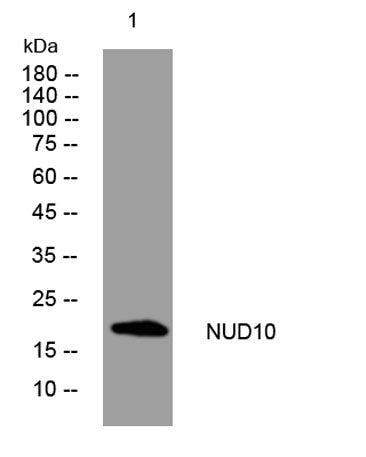
1
/
of
1
ELK Biotechnology
SKU:ES14436
NUD10 rabbit pAb
NUD10 rabbit pAb
Regular price
$250.00 USD
Regular price
Sale price
$250.00 USD
Unit price
/
per
Shipping calculated at checkout.
Couldn't load pickup availability
Applications: WB
Reactivity: Human; Mouse
Source: Rabbit
Dilution: WB 1:500-2000
Immunogen: Synthesized peptide derived from human NUD10 AA range: 92-142
Storage_stability: -20°C/1 year
Clonality: Polyclonal
Isotype: IgG
Concentration: 1 mg/ml
Human_gene_id: 170685
Human_swiss_prot_no: Q8NFP7
Subcellular_location: Cytoplasm .
Background: This gene is a member of the nudix (nucleoside diphosphate linked moiety X)-type motif containing family. The encoded protein is a phosphohydrolase and may regulate the turnover of diphosphoinositol polyphosphates. The turnover of these high-energy diphosphoinositol polyphosphates represents a molecular switching activity with important regulatory consequences. Molecular switching by diphosphoinositol polyphosphates may contribute to the regulation of intracellular trafficking. In some populations putative prostate cancer susceptibility alleles have been identified for this gene. Alternatively spliced transcript variants, which differ only in the 5' UTR, have been found for this gene. [provided by RefSeq, Feb 2015],
Reactivity: Human; Mouse
Source: Rabbit
Dilution: WB 1:500-2000
Immunogen: Synthesized peptide derived from human NUD10 AA range: 92-142
Storage_stability: -20°C/1 year
Clonality: Polyclonal
Isotype: IgG
Concentration: 1 mg/ml
Human_gene_id: 170685
Human_swiss_prot_no: Q8NFP7
Subcellular_location: Cytoplasm .
Background: This gene is a member of the nudix (nucleoside diphosphate linked moiety X)-type motif containing family. The encoded protein is a phosphohydrolase and may regulate the turnover of diphosphoinositol polyphosphates. The turnover of these high-energy diphosphoinositol polyphosphates represents a molecular switching activity with important regulatory consequences. Molecular switching by diphosphoinositol polyphosphates may contribute to the regulation of intracellular trafficking. In some populations putative prostate cancer susceptibility alleles have been identified for this gene. Alternatively spliced transcript variants, which differ only in the 5' UTR, have been found for this gene. [provided by RefSeq, Feb 2015],
Share