1
/
of
1
ELK Biotechnology
SKU:ES13856
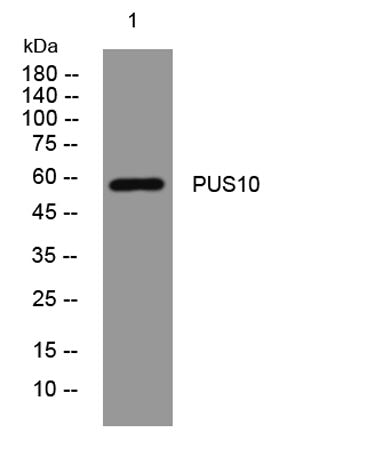
PUS10 rabbit pAb
PUS10 rabbit pAb
Regular price
$250.00 USD
Regular price
Sale price
$250.00 USD
Unit price
/
per
Shipping calculated at checkout.
Couldn't load pickup availability
Applications: WB; ELISA;IHC
Reactivity: Human; Mouse
Source: Rabbit
Dilution: WB 1:500-2000;IHC-p 1:50-300; ELISA 2000-20000
Immunogen: Synthesized peptide derived from human PUS10 AA range: 425-475
Storage_stability: -20°C/1 year
Clonality: Polyclonal
Isotype: IgG
Concentration: 1 mg/ml
Human_gene_id: 150962
Human_swiss_prot_no: Q3MIT2
Subcellular_location: Nucleus . Cytoplasm . Mitochondrion . Localizes mainly in the nucleus (Probable) (PubMed:31819270). tRNA pseudouridylate synthase activity is restricted to the cytoplasm (PubMed:31819270). Translocates from nucleus to mitochondria during TRAIL-induced apoptosis (PubMed:28981101). .
Background: Pseudouridination, the isomerization of uridine to pseudouridine, is the most common posttranscriptional nucleotide modification found in RNA and is essential for biologic functions such as spliceosome biogenesis. Pseudouridylate synthases, such as PUS10, catalyze pseudouridination of structural RNAs, including transfer, ribosomal, and splicing RNAs. These enzymes also act as RNA chaperones, facilitating the correct folding and assembly of tRNAs (McCleverty et al., 2007 [PubMed 17900615]).[supplied by OMIM, May 2009],
Reactivity: Human; Mouse
Source: Rabbit
Dilution: WB 1:500-2000;IHC-p 1:50-300; ELISA 2000-20000
Immunogen: Synthesized peptide derived from human PUS10 AA range: 425-475
Storage_stability: -20°C/1 year
Clonality: Polyclonal
Isotype: IgG
Concentration: 1 mg/ml
Human_gene_id: 150962
Human_swiss_prot_no: Q3MIT2
Subcellular_location: Nucleus . Cytoplasm . Mitochondrion . Localizes mainly in the nucleus (Probable) (PubMed:31819270). tRNA pseudouridylate synthase activity is restricted to the cytoplasm (PubMed:31819270). Translocates from nucleus to mitochondria during TRAIL-induced apoptosis (PubMed:28981101). .
Background: Pseudouridination, the isomerization of uridine to pseudouridine, is the most common posttranscriptional nucleotide modification found in RNA and is essential for biologic functions such as spliceosome biogenesis. Pseudouridylate synthases, such as PUS10, catalyze pseudouridination of structural RNAs, including transfer, ribosomal, and splicing RNAs. These enzymes also act as RNA chaperones, facilitating the correct folding and assembly of tRNAs (McCleverty et al., 2007 [PubMed 17900615]).[supplied by OMIM, May 2009],
Share