1
/
of
1
ELK Biotechnology
SKU:ES13828
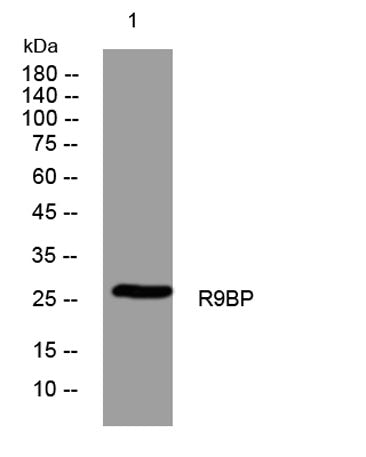
R9BP rabbit pAb
R9BP rabbit pAb
Regular price
$250.00 USD
Regular price
Sale price
$250.00 USD
Unit price
/
per
Shipping calculated at checkout.
Couldn't load pickup availability
Applications: WB;ELISA;IHC
Reactivity: Human; Mouse
Source: Rabbit
Dilution: WB 1:500-2000;IHC-p 1:50-300; ELISA 2000-20000
Immunogen: Synthesized peptide derived from human R9BP AA range: 138-188
Storage_stability: -20°C/1 year
Clonality: Polyclonal
Isotype: IgG
Concentration: 1 mg/ml
Human_gene_id: 388531
Human_swiss_prot_no: Q6ZS82
Subcellular_location: Membrane ; Single-pass type IV membrane protein .
Background: The protein encoded by this gene functions as a regulator of G protein-coupled receptor signaling in phototransduction. Studies in bovine and mouse show that this gene is expressed only in the retina, and is localized in the rod outer segment membranes. This protein is associated with a heterotetrameric complex, specifically interacting with the regulator of G-protein signaling 9, and appears to function as the membrane anchor for the other largely soluble interacting partners. Mutations in this gene are associated with prolonged electroretinal response suppression (PERRS), also known as bradyopsia. [provided by RefSeq, Mar 2010],
Reactivity: Human; Mouse
Source: Rabbit
Dilution: WB 1:500-2000;IHC-p 1:50-300; ELISA 2000-20000
Immunogen: Synthesized peptide derived from human R9BP AA range: 138-188
Storage_stability: -20°C/1 year
Clonality: Polyclonal
Isotype: IgG
Concentration: 1 mg/ml
Human_gene_id: 388531
Human_swiss_prot_no: Q6ZS82
Subcellular_location: Membrane ; Single-pass type IV membrane protein .
Background: The protein encoded by this gene functions as a regulator of G protein-coupled receptor signaling in phototransduction. Studies in bovine and mouse show that this gene is expressed only in the retina, and is localized in the rod outer segment membranes. This protein is associated with a heterotetrameric complex, specifically interacting with the regulator of G-protein signaling 9, and appears to function as the membrane anchor for the other largely soluble interacting partners. Mutations in this gene are associated with prolonged electroretinal response suppression (PERRS), also known as bradyopsia. [provided by RefSeq, Mar 2010],
Share