1
/
of
1
ELK Biotechnology
SKU:ES13248
S26A8 rabbit pAb
S26A8 rabbit pAb
Regular price
$250.00 USD
Regular price
Sale price
$250.00 USD
Unit price
/
per
Shipping calculated at checkout.
Couldn't load pickup availability
Applications: WB
Reactivity: Human; Mouse
Source: Rabbit
Dilution: WB 1:500-2000
Immunogen: Synthesized peptide derived from human S26A8 AA range: 82-132
Storage_stability: -20°C/1 year
Clonality: Polyclonal
Isotype: IgG
Concentration: 1 mg/ml
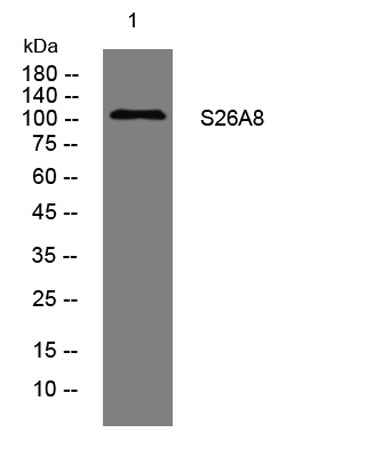
Observed_band(KD): 105kD
Human_gene_id: 116369
Human_swiss_prot_no: Q96RN1
Subcellular_location: Membrane ; Multi-pass membrane protein . Located at the annulus ring structure within the sperm cell. .
Other_name: Testis anion transporter 1 (Anion exchange transporter) (Solute carrier family 26 member 8)
Background: This gene encodes a member of the SLC26 gene family of anion transporters. Family members are well conserved in gene structure and protein length yet have markedly different tissue expression patterns. The expression of this gene appears to be restricted to spermatocytes. Alternatively spliced transcript variants that encode different isoforms have been described. [provided by RefSeq, Jul 2010],
Reactivity: Human; Mouse
Source: Rabbit
Dilution: WB 1:500-2000
Immunogen: Synthesized peptide derived from human S26A8 AA range: 82-132
Storage_stability: -20°C/1 year
Clonality: Polyclonal
Isotype: IgG
Concentration: 1 mg/ml
Observed_band(KD): 105kD
Human_gene_id: 116369
Human_swiss_prot_no: Q96RN1
Subcellular_location: Membrane ; Multi-pass membrane protein . Located at the annulus ring structure within the sperm cell. .
Other_name: Testis anion transporter 1 (Anion exchange transporter) (Solute carrier family 26 member 8)
Background: This gene encodes a member of the SLC26 gene family of anion transporters. Family members are well conserved in gene structure and protein length yet have markedly different tissue expression patterns. The expression of this gene appears to be restricted to spermatocytes. Alternatively spliced transcript variants that encode different isoforms have been described. [provided by RefSeq, Jul 2010],
Share