1
/
of
1
ELK Biotechnology
SKU:ES13139
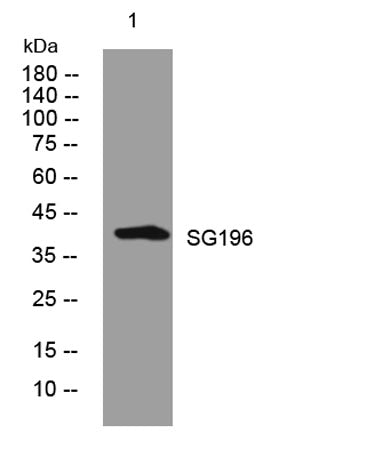
SG196 rabbit pAb
SG196 rabbit pAb
Regular price
$250.00 USD
Regular price
Sale price
$250.00 USD
Unit price
/
per
Shipping calculated at checkout.
Couldn't load pickup availability
Applications: WB;IHC
Reactivity: Human; Mouse;Rat
Source: Rabbit
Dilution: WB 1:500-2000;IHC-p 1:50-300
Immunogen: Synthesized peptide derived from human SG196 AA range: 178-228
Storage_stability: -20°C/1 year
Clonality: Polyclonal
Isotype: IgG
Concentration: 1 mg/ml
Human_gene_id: 84197
Human_swiss_prot_no: Q9H5K3
Subcellular_location: Endoplasmic reticulum membrane ; Single-pass type II membrane protein .
Background: This gene encodes a protein that may be involved in the presentation of the laminin-binding O-linked carbohydrate chain of alpha-dystroglycan (a-DG), which forms transmembrane linkages between the extracellular matrix and the exoskeleton. Some pathogens use this O-linked carbohydrate unit for host entry. Loss of function compound heterozygous mutations in this gene were found in a human patient affected by the Walker-Warburg syndrome (WWS) phenotype. Mice lacking this gene contain misplaced neurons (heterotopia) in some regions of the brain, possibly from defects in neuronal migration. Alternative splicing of this gene results in multiple transcript variants. [provided by RefSeq, May 2013],
Reactivity: Human; Mouse;Rat
Source: Rabbit
Dilution: WB 1:500-2000;IHC-p 1:50-300
Immunogen: Synthesized peptide derived from human SG196 AA range: 178-228
Storage_stability: -20°C/1 year
Clonality: Polyclonal
Isotype: IgG
Concentration: 1 mg/ml
Human_gene_id: 84197
Human_swiss_prot_no: Q9H5K3
Subcellular_location: Endoplasmic reticulum membrane ; Single-pass type II membrane protein .
Background: This gene encodes a protein that may be involved in the presentation of the laminin-binding O-linked carbohydrate chain of alpha-dystroglycan (a-DG), which forms transmembrane linkages between the extracellular matrix and the exoskeleton. Some pathogens use this O-linked carbohydrate unit for host entry. Loss of function compound heterozygous mutations in this gene were found in a human patient affected by the Walker-Warburg syndrome (WWS) phenotype. Mice lacking this gene contain misplaced neurons (heterotopia) in some regions of the brain, possibly from defects in neuronal migration. Alternative splicing of this gene results in multiple transcript variants. [provided by RefSeq, May 2013],
Share