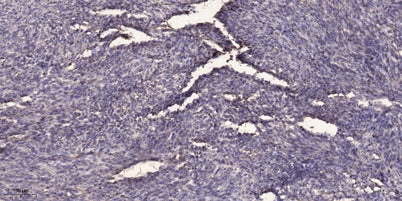
1
/
of
1
ELK Biotechnology
SKU:ES12965
SQSTM1/p62 (phospho-Ser403) rabbit pAb
SQSTM1/p62 (phospho-Ser403) rabbit pAb
Regular price
$250.00 USD
Regular price
Sale price
$250.00 USD
Unit price
/
per
Shipping calculated at checkout.
Couldn't load pickup availability
Applications: WB;IHC
Reactivity: Human;Mouse;Rat
Source: Rabbit
Dilution: WB 1:500-2000;IHC-p 1:50-300
Immunogen: Synthesized phosho peptide around human SQSTM1 (Ser403)
Storage_stability: -20°C/1 year
Clonality: Polyclonal
Isotype: IgG
Concentration: 1 mg/ml
Observed_band(KD): 50kD
Human_gene_id: 8878
Human_swiss_prot_no: Q13501
Subcellular_location: Cytoplasm, cytosol . Late endosome. Lysosome. Cytoplasmic vesicle, autophagosome. Nucleus. Endoplasmic reticulum. Nucleus, PML body . Cytoplasm, myofibril, sarcomere . In cardiac muscle, localizes to the sarcomeric band (By similarity). Commonly found in inclusion bodies containing polyubiquitinated protein aggregates. In neurodegenerative diseases, detected in Lewy bodies in Parkinson disease, neurofibrillary tangles in Alzheimer disease, and HTT aggregates in Huntington disease. In protein aggregate diseases of the liver, found in large amounts in Mallory bodies of alcoholic and nonalcoholic steatohepatitis, hyaline bodies in hepatocellular carcinoma, and in SERPINA1 aggregates. Enriched in Rosenthal fibers of pilocytic astrocytoma. In the cytoplasm, observed in both membrane-free ubiqui
Other_name: Sequestosome-1 (EBI3-associated protein of 60 kDa) (EBIAP) (p60) (Phosphotyrosine-independent ligand for the Lck SH2 domain of 62 kDa) (Ubiquitin-binding protein p62)
Background: This gene encodes a multifunctional protein that binds ubiquitin and regulates activation of the nuclear factor kappa-B (NF-kB) signaling pathway. The protein functions as a scaffolding/adaptor protein in concert with TNF receptor-associated factor 6 to mediate activation of NF-kB in response to upstream signals. Alternatively spliced transcript variants encoding either the same or different isoforms have been identified for this gene. Mutations in this gene result in sporadic and familial Paget disease of bone. [provided by RefSeq, Mar 2009],
Reactivity: Human;Mouse;Rat
Source: Rabbit
Dilution: WB 1:500-2000;IHC-p 1:50-300
Immunogen: Synthesized phosho peptide around human SQSTM1 (Ser403)
Storage_stability: -20°C/1 year
Clonality: Polyclonal
Isotype: IgG
Concentration: 1 mg/ml
Observed_band(KD): 50kD
Human_gene_id: 8878
Human_swiss_prot_no: Q13501
Subcellular_location: Cytoplasm, cytosol . Late endosome. Lysosome. Cytoplasmic vesicle, autophagosome. Nucleus. Endoplasmic reticulum. Nucleus, PML body . Cytoplasm, myofibril, sarcomere . In cardiac muscle, localizes to the sarcomeric band (By similarity). Commonly found in inclusion bodies containing polyubiquitinated protein aggregates. In neurodegenerative diseases, detected in Lewy bodies in Parkinson disease, neurofibrillary tangles in Alzheimer disease, and HTT aggregates in Huntington disease. In protein aggregate diseases of the liver, found in large amounts in Mallory bodies of alcoholic and nonalcoholic steatohepatitis, hyaline bodies in hepatocellular carcinoma, and in SERPINA1 aggregates. Enriched in Rosenthal fibers of pilocytic astrocytoma. In the cytoplasm, observed in both membrane-free ubiqui
Other_name: Sequestosome-1 (EBI3-associated protein of 60 kDa) (EBIAP) (p60) (Phosphotyrosine-independent ligand for the Lck SH2 domain of 62 kDa) (Ubiquitin-binding protein p62)
Background: This gene encodes a multifunctional protein that binds ubiquitin and regulates activation of the nuclear factor kappa-B (NF-kB) signaling pathway. The protein functions as a scaffolding/adaptor protein in concert with TNF receptor-associated factor 6 to mediate activation of NF-kB in response to upstream signals. Alternatively spliced transcript variants encoding either the same or different isoforms have been identified for this gene. Mutations in this gene result in sporadic and familial Paget disease of bone. [provided by RefSeq, Mar 2009],
Share