1
/
of
1
ELK Biotechnology
SKU:ES12781
TCA rabbit pAb
TCA rabbit pAb
Regular price
$250.00 USD
Regular price
Sale price
$250.00 USD
Unit price
/
per
Shipping calculated at checkout.
Couldn't load pickup availability
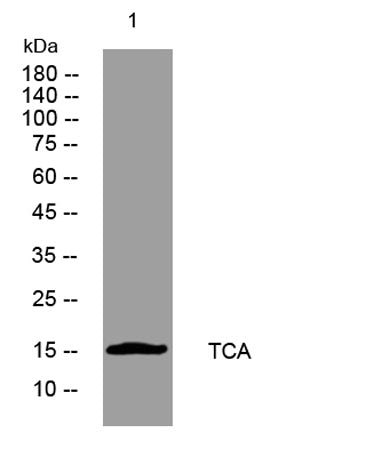
Applications: WB
Reactivity: Human; Mouse
Source: Rabbit
Dilution: WB 1:500-2000
Immunogen: Synthesized peptide derived from human TCA AA range: 58-108
Storage_stability: -20°C/1 year
Clonality: Polyclonal
Isotype: IgG
Concentration: 1 mg/ml
Human_swiss_prot_no: P01848
Subcellular_location: Cell membrane .
Background: T cell receptors recognize foreign antigens which have been processed as small peptides and bound to major histocompatibility complex (MHC) molecules at the surface of antigen presenting cells (APC). Each T cell receptor is a dimer consisting of one alpha and one beta chain or one delta and one gamma chain. In a single cell, the T cell receptor loci are rearranged and expressed in the order delta, gamma, beta, and alpha. If both delta and gamma rearrangements produce functional chains, the cell expresses delta and gamma. If not, the cell proceeds to rearrange the beta and alpha loci. This region represents the germline organization of the T cell receptor alpha and delta loci. Both the alpha and delta loci include V (variable), J (joining), and C (constant) segments and the delta locus also includes diversity (D) segments. The delta locus is situated within the alpha locus, between the alpha V and J segments. During T cell development, the delta chain is synthesized by a recombination event at the DNA level joining a D segment with a J segment; a V segment is then joined to the D-J gene. The alpha chain is synthesized by recombination joining a single V segment with a J segment. For both chains, the C segment is later joined by splicing at the RNA level. Recombination of many different V segments with several J segments provides a wide range of antigen recognition. Additional diversity is attained by junctional diversity, resulting from the random additional of nucleotides by terminal deoxynucleotidyltransferase. Five variable segments can be used in either alpha or delta chains and are described by TRAV/DV symbols. Several V and J segments of the alpha locus are known to be incapable of encoding a protein and are considered pseudogenes. [provided by RefSeq, Aug 2016],
Reactivity: Human; Mouse
Source: Rabbit
Dilution: WB 1:500-2000
Immunogen: Synthesized peptide derived from human TCA AA range: 58-108
Storage_stability: -20°C/1 year
Clonality: Polyclonal
Isotype: IgG
Concentration: 1 mg/ml
Human_swiss_prot_no: P01848
Subcellular_location: Cell membrane .
Background: T cell receptors recognize foreign antigens which have been processed as small peptides and bound to major histocompatibility complex (MHC) molecules at the surface of antigen presenting cells (APC). Each T cell receptor is a dimer consisting of one alpha and one beta chain or one delta and one gamma chain. In a single cell, the T cell receptor loci are rearranged and expressed in the order delta, gamma, beta, and alpha. If both delta and gamma rearrangements produce functional chains, the cell expresses delta and gamma. If not, the cell proceeds to rearrange the beta and alpha loci. This region represents the germline organization of the T cell receptor alpha and delta loci. Both the alpha and delta loci include V (variable), J (joining), and C (constant) segments and the delta locus also includes diversity (D) segments. The delta locus is situated within the alpha locus, between the alpha V and J segments. During T cell development, the delta chain is synthesized by a recombination event at the DNA level joining a D segment with a J segment; a V segment is then joined to the D-J gene. The alpha chain is synthesized by recombination joining a single V segment with a J segment. For both chains, the C segment is later joined by splicing at the RNA level. Recombination of many different V segments with several J segments provides a wide range of antigen recognition. Additional diversity is attained by junctional diversity, resulting from the random additional of nucleotides by terminal deoxynucleotidyltransferase. Five variable segments can be used in either alpha or delta chains and are described by TRAV/DV symbols. Several V and J segments of the alpha locus are known to be incapable of encoding a protein and are considered pseudogenes. [provided by RefSeq, Aug 2016],
Share