1
/
of
1
ELK Biotechnology
SKU:ES12767
TDH rabbit pAb
TDH rabbit pAb
Regular price
$250.00 USD
Regular price
Sale price
$250.00 USD
Unit price
/
per
Shipping calculated at checkout.
Couldn't load pickup availability
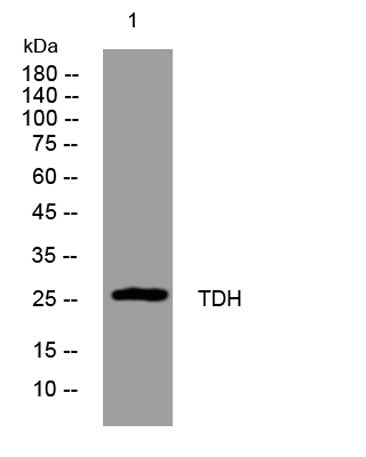
Applications: WB
Reactivity: Human; Mouse
Source: Rabbit
Dilution: WB 1:500-2000
Immunogen: Synthesized peptide derived from human TDH AA range: 169-219
Storage_stability: -20°C/1 year
Clonality: Polyclonal
Isotype: IgG
Concentration: 1 mg/ml
Human_swiss_prot_no: Q8IZJ6
Subcellular_location: Mitochondrion .
Background: This gene appears to be an evolving pseudogene of L-threonine 3-dehydrogenase (TDH). In both prokaryotes and eukaryotes, TDH catalyzes the first of two steps in one of two L-threonine degradation pathways. However, in human, the single gene with sequence similarity to TDH is not capable of encoding a functional TDH protein; the predicted protein lacks most of the C-terminus and parts of the NAD+ binding motif when compared to other species' TDH proteins. This suggests that the human gene is therefore a pseudogene. Transcripts of this gene are found in all tissues and alternatively spliced transcripts have been described. It is not known if these transcripts are translated, or if the possible protein product provides any functional role. [provided by RefSeq, Jul 2008],
Reactivity: Human; Mouse
Source: Rabbit
Dilution: WB 1:500-2000
Immunogen: Synthesized peptide derived from human TDH AA range: 169-219
Storage_stability: -20°C/1 year
Clonality: Polyclonal
Isotype: IgG
Concentration: 1 mg/ml
Human_swiss_prot_no: Q8IZJ6
Subcellular_location: Mitochondrion .
Background: This gene appears to be an evolving pseudogene of L-threonine 3-dehydrogenase (TDH). In both prokaryotes and eukaryotes, TDH catalyzes the first of two steps in one of two L-threonine degradation pathways. However, in human, the single gene with sequence similarity to TDH is not capable of encoding a functional TDH protein; the predicted protein lacks most of the C-terminus and parts of the NAD+ binding motif when compared to other species' TDH proteins. This suggests that the human gene is therefore a pseudogene. Transcripts of this gene are found in all tissues and alternatively spliced transcripts have been described. It is not known if these transcripts are translated, or if the possible protein product provides any functional role. [provided by RefSeq, Jul 2008],
Share