1
/
of
1
ELK Biotechnology
SKU:ES12561
Trk A (Phospho-Y496) Rabbit pAb
Trk A (Phospho-Y496) Rabbit pAb
Regular price
$250.00 USD
Regular price
Sale price
$250.00 USD
Unit price
/
per
Shipping calculated at checkout.
Couldn't load pickup availability
Applications: WB; IF; ELISA
Reactivity: Human; Mouse; Rat
Source: Rabbit
Dilution: WB 1:500-2000; IF/ICC 1:100-500; ELISA 1:5000-20000
Immunogen: Synthesized pospho peptide derived from human Trk A (Phospho-Y496)
Storage_stability: -20°C/1 year
Clonality: Polyclonal
Isotype: IgG
Concentration: 1 mg/ml
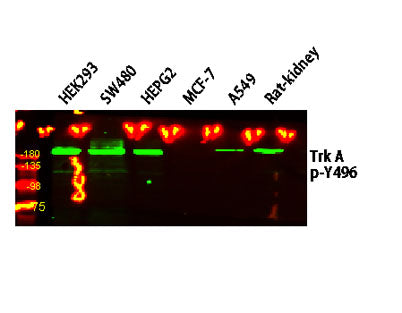
Observed_band(KD): 180kD
Human_gene_id: 4914
Human_swiss_prot_no: P04629
Subcellular_location: Cell membrane ; Single-pass type I membrane protein . Early endosome membrane ; Single-pass type I membrane protein . Late endosome membrane ; Single-pass type I membrane protein . Recycling endosome membrane ; Single-pass type I membrane protein . Rapidly internalized after NGF binding (PubMed:1281417). Internalized to endosomes upon binding of NGF or NTF3 and further transported to the cell body via a retrograde axonal transport. Localized at cell membrane and early endosomes before nerve growth factor (NGF) stimulation. Recruited to late endosomes after NGF stimulation. Colocalized with RAPGEF2 at late endosomes. .
Other_name: High affinity nerve growth factor receptor (EC 2.7.10.1;Neurotrophic tyrosine kinase receptor type 1;TRK1-transforming tyrosine kinase protein;Tropomyosin-related kinase A;Tyrosine kinase receptor;Tyrosine kinase receptor A;Trk-A;gp140trk;p140-TrkA)
Background: This gene encodes a member of the neurotrophic tyrosine kinase receptor (NTKR) family. This kinase is a membrane-bound receptor that, upon neurotrophin binding, phosphorylates itself and members of the MAPK pathway. The presence of this kinase leads to cell differentiation and may play a role in specifying sensory neuron subtypes. Mutations in this gene have been associated with congenital insensitivity to pain, anhidrosis, self-mutilating behavior, mental retardation and cancer. Alternate transcriptional splice variants of this gene have been found, but only three have been characterized to date. [provided by RefSeq, Jul 2008],
Reactivity: Human; Mouse; Rat
Source: Rabbit
Dilution: WB 1:500-2000; IF/ICC 1:100-500; ELISA 1:5000-20000
Immunogen: Synthesized pospho peptide derived from human Trk A (Phospho-Y496)
Storage_stability: -20°C/1 year
Clonality: Polyclonal
Isotype: IgG
Concentration: 1 mg/ml
Observed_band(KD): 180kD
Human_gene_id: 4914
Human_swiss_prot_no: P04629
Subcellular_location: Cell membrane ; Single-pass type I membrane protein . Early endosome membrane ; Single-pass type I membrane protein . Late endosome membrane ; Single-pass type I membrane protein . Recycling endosome membrane ; Single-pass type I membrane protein . Rapidly internalized after NGF binding (PubMed:1281417). Internalized to endosomes upon binding of NGF or NTF3 and further transported to the cell body via a retrograde axonal transport. Localized at cell membrane and early endosomes before nerve growth factor (NGF) stimulation. Recruited to late endosomes after NGF stimulation. Colocalized with RAPGEF2 at late endosomes. .
Other_name: High affinity nerve growth factor receptor (EC 2.7.10.1;Neurotrophic tyrosine kinase receptor type 1;TRK1-transforming tyrosine kinase protein;Tropomyosin-related kinase A;Tyrosine kinase receptor;Tyrosine kinase receptor A;Trk-A;gp140trk;p140-TrkA)
Background: This gene encodes a member of the neurotrophic tyrosine kinase receptor (NTKR) family. This kinase is a membrane-bound receptor that, upon neurotrophin binding, phosphorylates itself and members of the MAPK pathway. The presence of this kinase leads to cell differentiation and may play a role in specifying sensory neuron subtypes. Mutations in this gene have been associated with congenital insensitivity to pain, anhidrosis, self-mutilating behavior, mental retardation and cancer. Alternate transcriptional splice variants of this gene have been found, but only three have been characterized to date. [provided by RefSeq, Jul 2008],
Share