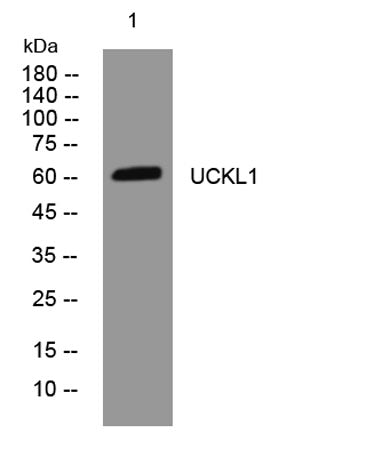
1
/
of
1
ELK Biotechnology
SKU:ES12437
UCKL1 rabbit pAb
UCKL1 rabbit pAb
Regular price
$250.00 USD
Regular price
Sale price
$250.00 USD
Unit price
/
per
Shipping calculated at checkout.
Couldn't load pickup availability
Applications: WB
Reactivity: Human; Mouse
Source: Rabbit
Dilution: WB 1:500-2000
Immunogen: Synthesized peptide derived from human UCKL1 AA range: 223-273
Storage_stability: -20°C/1 year
Clonality: Polyclonal
Isotype: IgG
Concentration: 1 mg/ml
Human_gene_id: 54963
Human_swiss_prot_no: Q9NWZ5
Subcellular_location: Cytoplasm . Nucleus . EBNA3 induces isoform 1 translocation to the nucleus, whereas it does change isoform 3 location.
Background: The protein encoded by this gene is a uridine kinase. Uridine kinases catalyze the phosphorylation of uridine to uridine monophosphate. This protein has been shown to bind to Epstein-Barr nuclear antigen 3 as well as natural killer lytic-associated molecule. Ubiquitination of this protein is enhanced by the presence of natural killer lytic-associated molecule. In addition, protein levels decrease in the presence of natural killer lytic-associated molecule, suggesting that association with natural killer lytic-associated molecule results in ubiquitination and subsequent degradation of this protein. Alternative splicing results in multiple transcript variants. [provided by RefSeq, Nov 2014],
Reactivity: Human; Mouse
Source: Rabbit
Dilution: WB 1:500-2000
Immunogen: Synthesized peptide derived from human UCKL1 AA range: 223-273
Storage_stability: -20°C/1 year
Clonality: Polyclonal
Isotype: IgG
Concentration: 1 mg/ml
Human_gene_id: 54963
Human_swiss_prot_no: Q9NWZ5
Subcellular_location: Cytoplasm . Nucleus . EBNA3 induces isoform 1 translocation to the nucleus, whereas it does change isoform 3 location.
Background: The protein encoded by this gene is a uridine kinase. Uridine kinases catalyze the phosphorylation of uridine to uridine monophosphate. This protein has been shown to bind to Epstein-Barr nuclear antigen 3 as well as natural killer lytic-associated molecule. Ubiquitination of this protein is enhanced by the presence of natural killer lytic-associated molecule. In addition, protein levels decrease in the presence of natural killer lytic-associated molecule, suggesting that association with natural killer lytic-associated molecule results in ubiquitination and subsequent degradation of this protein. Alternative splicing results in multiple transcript variants. [provided by RefSeq, Nov 2014],
Share