1
/
of
1
ELK Biotechnology
SKU:ES11301
CHIP rabbit pAb
CHIP rabbit pAb
Regular price
$250.00 USD
Regular price
Sale price
$250.00 USD
Unit price
/
per
Shipping calculated at checkout.
Couldn't load pickup availability
Applications: WB;ELISA
Reactivity: Human;Mouse
Source: Rabbit
Dilution: WB 1:500-2000 ELISA 1:5000-20000
Immunogen: Synthesized peptide derived from human protein . at AA range: 160-240
Storage_stability: -20°C/1 year
Clonality: Polyclonal
Isotype: IgG
Concentration: 1 mg/ml
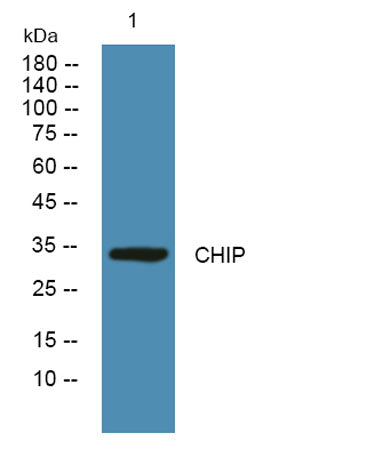
Observed_band(KD): 33kD
Human_gene_id: 10273
Human_swiss_prot_no: Q9UNE7
Subcellular_location: Cytoplasm . Nucleus . Translocates to the nucleus in response to inflammatory signals in regulatory T-cells (Treg). .
Background: This gene encodes a protein containing tetratricopeptide repeat and a U-box that functions as a ubiquitin ligase/cochaperone. The encoded protein binds to and ubiquitinates shock cognate 71 kDa protein (Hspa8) and DNA polymerase beta (Polb), among other targets. Mutations in this gene cause spinocerebellar ataxia, autosomal recessive 16. Alternative splicing results in multiple transcript variants. There is a pseudogene for this gene on chromosome 2. [provided by RefSeq, Jun 2014],
Reactivity: Human;Mouse
Source: Rabbit
Dilution: WB 1:500-2000 ELISA 1:5000-20000
Immunogen: Synthesized peptide derived from human protein . at AA range: 160-240
Storage_stability: -20°C/1 year
Clonality: Polyclonal
Isotype: IgG
Concentration: 1 mg/ml
Observed_band(KD): 33kD
Human_gene_id: 10273
Human_swiss_prot_no: Q9UNE7
Subcellular_location: Cytoplasm . Nucleus . Translocates to the nucleus in response to inflammatory signals in regulatory T-cells (Treg). .
Background: This gene encodes a protein containing tetratricopeptide repeat and a U-box that functions as a ubiquitin ligase/cochaperone. The encoded protein binds to and ubiquitinates shock cognate 71 kDa protein (Hspa8) and DNA polymerase beta (Polb), among other targets. Mutations in this gene cause spinocerebellar ataxia, autosomal recessive 16. Alternative splicing results in multiple transcript variants. There is a pseudogene for this gene on chromosome 2. [provided by RefSeq, Jun 2014],
Share