1
/
of
1
ELK Biotechnology
SKU:ES11092
KLK13 rabbit pAb
KLK13 rabbit pAb
Regular price
$250.00 USD
Regular price
Sale price
$250.00 USD
Unit price
/
per
Shipping calculated at checkout.
Couldn't load pickup availability
Applications: WB;ELISA
Reactivity: Human;Rat;Mouse;
Source: Rabbit
Dilution: WB 1:500-2000 ELISA 1:5000-20000
Immunogen: Synthesized peptide derived from part region of human protein
Storage_stability: -20°C/1 year
Clonality: Polyclonal
Isotype: IgG
Concentration: 1 mg/ml
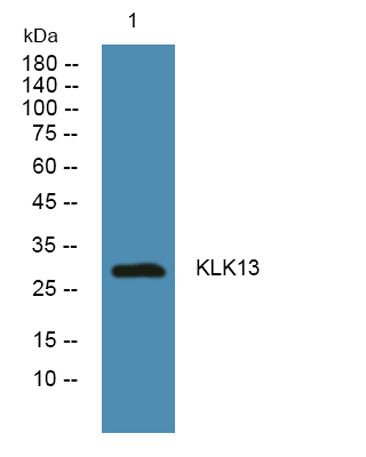
Observed_band(KD): 30kD
Human_gene_id: 26085
Human_swiss_prot_no: Q9UKR3
Subcellular_location: Secreted .
Background: Kallikreins are a subgroup of serine proteases having diverse physiological functions. Growing evidence suggests that many kallikreins are implicated in carcinogenesis and some have potential as novel cancer and other disease biomarkers. This gene is one of the fifteen kallikrein subfamily members located in a cluster on chromosome 19. Expression of this gene is regulated by steroid hormones and may be useful as a marker for breast cancer. An additional transcript variant has been identified, but its full length sequence has not been determined. [provided by RefSeq, Jul 2008],
Reactivity: Human;Rat;Mouse;
Source: Rabbit
Dilution: WB 1:500-2000 ELISA 1:5000-20000
Immunogen: Synthesized peptide derived from part region of human protein
Storage_stability: -20°C/1 year
Clonality: Polyclonal
Isotype: IgG
Concentration: 1 mg/ml
Observed_band(KD): 30kD
Human_gene_id: 26085
Human_swiss_prot_no: Q9UKR3
Subcellular_location: Secreted .
Background: Kallikreins are a subgroup of serine proteases having diverse physiological functions. Growing evidence suggests that many kallikreins are implicated in carcinogenesis and some have potential as novel cancer and other disease biomarkers. This gene is one of the fifteen kallikrein subfamily members located in a cluster on chromosome 19. Expression of this gene is regulated by steroid hormones and may be useful as a marker for breast cancer. An additional transcript variant has been identified, but its full length sequence has not been determined. [provided by RefSeq, Jul 2008],
Share