1
/
of
1
ELK Biotechnology
SKU:ES11068
MSMB rabbit pAb
MSMB rabbit pAb
Regular price
$250.00 USD
Regular price
Sale price
$250.00 USD
Unit price
/
per
Shipping calculated at checkout.
Couldn't load pickup availability
Applications: WB;ELISA
Reactivity: Human;Rat;Mouse
Source: Rabbit
Dilution: WB 1:500-2000 ELISA 1:5000-20000
Immunogen: Synthesized peptide derived from part region of human protein AA range: 61-110
Storage_stability: -20°C/1 year
Clonality: Polyclonal
Isotype: IgG
Concentration: 1 mg/ml
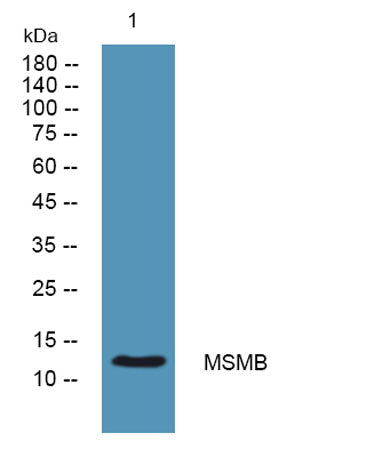
Observed_band(KD): 12kD
Human_gene_id: 4477
Human_swiss_prot_no: P08118
Subcellular_location: Secreted. Sperm surface.
Background: The protein encoded by this gene is a member of the immunoglobulin binding factor family. It is synthesized by the epithelial cells of the prostate gland and secreted into the seminal plasma. This protein has inhibin-like activity. It may have a role as an autocrine paracrine factor in uterine, breast and other female reproductive tissues. The expression of the encoded protein is found to be decreased in prostate cancer. Two alternatively spliced transcript variants encoding different isoforms are described for this gene. The use of alternate polyadenylation sites has been found for this gene. [provided by RefSeq, Jul 2008],
Reactivity: Human;Rat;Mouse
Source: Rabbit
Dilution: WB 1:500-2000 ELISA 1:5000-20000
Immunogen: Synthesized peptide derived from part region of human protein AA range: 61-110
Storage_stability: -20°C/1 year
Clonality: Polyclonal
Isotype: IgG
Concentration: 1 mg/ml
Observed_band(KD): 12kD
Human_gene_id: 4477
Human_swiss_prot_no: P08118
Subcellular_location: Secreted. Sperm surface.
Background: The protein encoded by this gene is a member of the immunoglobulin binding factor family. It is synthesized by the epithelial cells of the prostate gland and secreted into the seminal plasma. This protein has inhibin-like activity. It may have a role as an autocrine paracrine factor in uterine, breast and other female reproductive tissues. The expression of the encoded protein is found to be decreased in prostate cancer. Two alternatively spliced transcript variants encoding different isoforms are described for this gene. The use of alternate polyadenylation sites has been found for this gene. [provided by RefSeq, Jul 2008],
Share