1
/
of
1
ELK Biotechnology
SKU:ES10885
NR2E3 rabbit pAb
NR2E3 rabbit pAb
Regular price
$250.00 USD
Regular price
Sale price
$250.00 USD
Unit price
/
per
Shipping calculated at checkout.
Couldn't load pickup availability
Applications: WB;ELISA
Reactivity: Human;Mouse
Source: Rabbit
Dilution: WB 1:500-2000 ELISA 1:5000-20000
Immunogen: Synthesized peptide derived from part region of human protein
Storage_stability: -20°C/1 year
Clonality: Polyclonal
Isotype: IgG
Concentration: 1 mg/ml
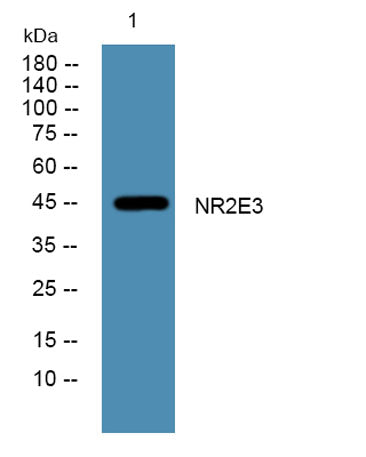
Observed_band(KD): 45kD
Human_gene_id: 10002
Human_swiss_prot_no: Q9Y5X4
Subcellular_location: Nucleus .
Background: This protein is part of a large family of nuclear receptor transcription factors involved in signaling pathways. Nuclear receptors have been shown to regulate pathways involved in embryonic development, as well as in maintenance of proper cell function in adults. Members of this family are characterized by discrete domains that function in DNA and ligand binding. This gene encodes a retinal nuclear receptor that is a ligand-dependent transcription factor. Defects in this gene are a cause of enhanced S cone syndrome. Alternatively spliced transcript variants encoding different isoforms have been identified. [provided by RefSeq, Jul 2008],
Reactivity: Human;Mouse
Source: Rabbit
Dilution: WB 1:500-2000 ELISA 1:5000-20000
Immunogen: Synthesized peptide derived from part region of human protein
Storage_stability: -20°C/1 year
Clonality: Polyclonal
Isotype: IgG
Concentration: 1 mg/ml
Observed_band(KD): 45kD
Human_gene_id: 10002
Human_swiss_prot_no: Q9Y5X4
Subcellular_location: Nucleus .
Background: This protein is part of a large family of nuclear receptor transcription factors involved in signaling pathways. Nuclear receptors have been shown to regulate pathways involved in embryonic development, as well as in maintenance of proper cell function in adults. Members of this family are characterized by discrete domains that function in DNA and ligand binding. This gene encodes a retinal nuclear receptor that is a ligand-dependent transcription factor. Defects in this gene are a cause of enhanced S cone syndrome. Alternatively spliced transcript variants encoding different isoforms have been identified. [provided by RefSeq, Jul 2008],
Share