1
/
of
1
ELK Biotechnology
SKU:ES10740
NSA2 rabbit pAb
NSA2 rabbit pAb
Regular price
$250.00 USD
Regular price
Sale price
$250.00 USD
Unit price
/
per
Shipping calculated at checkout.
Couldn't load pickup availability
Applications: WB;ELISA
Reactivity: Human;Mouse;Rat
Source: Rabbit
Dilution: WB 1:500-2000 ELISA 1:5000-20000
Immunogen: Synthesized peptide derived from part region of human protein
Storage_stability: -20°C/1 year
Clonality: Polyclonal
Isotype: IgG
Concentration: 1 mg/ml
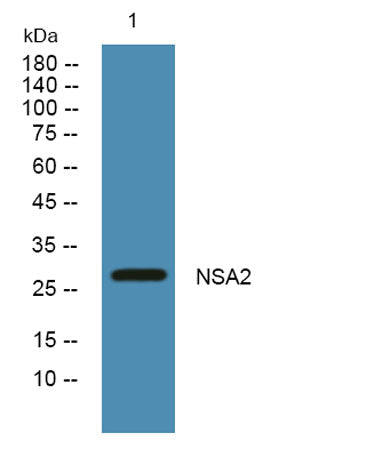
Observed_band(KD): 28kD
Human_gene_id: 10412
Human_swiss_prot_no: O95478
Subcellular_location: Nucleus, nucleolus .
Background: NSA2, ribosome biogenesis homolog(NSA2) Homo sapiens This gene encodes a nucleolar protein involved in cell cycle regulation and proliferation. This gene was identified based on sequence similarity to a highly conserved Saccharomyces cerevisiae gene encoding a pre-ribosomal protein, which is involved in large ribosomal subunit biogenesis. The encoded protein is found at elevated levels in diabetic nephropathy. Alternative splicing results in multiple transcript variants. Several related pseudogenes have been identified. [provided by RefSeq, Nov 2012],
Reactivity: Human;Mouse;Rat
Source: Rabbit
Dilution: WB 1:500-2000 ELISA 1:5000-20000
Immunogen: Synthesized peptide derived from part region of human protein
Storage_stability: -20°C/1 year
Clonality: Polyclonal
Isotype: IgG
Concentration: 1 mg/ml
Observed_band(KD): 28kD
Human_gene_id: 10412
Human_swiss_prot_no: O95478
Subcellular_location: Nucleus, nucleolus .
Background: NSA2, ribosome biogenesis homolog(NSA2) Homo sapiens This gene encodes a nucleolar protein involved in cell cycle regulation and proliferation. This gene was identified based on sequence similarity to a highly conserved Saccharomyces cerevisiae gene encoding a pre-ribosomal protein, which is involved in large ribosomal subunit biogenesis. The encoded protein is found at elevated levels in diabetic nephropathy. Alternative splicing results in multiple transcript variants. Several related pseudogenes have been identified. [provided by RefSeq, Nov 2012],
Share