1
/
of
1
ELK Biotechnology
SKU:ES10718
ITBP1 rabbit pAb
ITBP1 rabbit pAb
Regular price
$250.00 USD
Regular price
Sale price
$250.00 USD
Unit price
/
per
Shipping calculated at checkout.
Couldn't load pickup availability
Applications: WB;ELISA
Reactivity: Human;Mouse
Source: Rabbit
Dilution: WB 1:500-2000 ELISA 1:5000-20000
Immunogen: Synthesized peptide derived from part region of human protein
Storage_stability: -20°C/1 year
Clonality: Polyclonal
Isotype: IgG
Concentration: 1 mg/ml
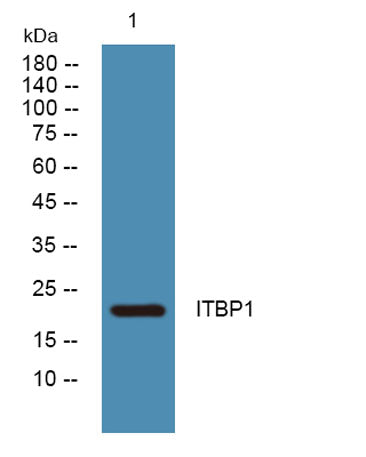
Observed_band(KD): 22kD
Human_gene_id: 9270
Human_swiss_prot_no: O14713
Subcellular_location: Nucleus. Cytoplasm. Cytoplasm, cytoskeleton . Cell membrane . Cell projection, lamellipodium. Cell projection, ruffle. Nucleocytoplasmic shuttling protein; shuttles between nucleus and cytoplasm in a integrin-dependent manner; probably sequestered in the cytosol by ITGB1. Its localization is dependent on the stage of cell spreading on fibronectin; cytoplasmic in case of round cells, corresponding to the initial step of cell spreading, or nuclear in case of well spread cells. Colocalizes with ROCK1 and NME2 at beta-1 integrin engagement sites. Together with ITGB1 and NME2 is recruited to beta-1 integrin-rich peripheral ruffles and lamellipodia during initial cell spreading on fibronectin and/or collagen.
Background: The cytoplasmic domains of integrins are essential for cell adhesion. The protein encoded by this gene binds to the beta1 integrin cytoplasmic domain. The interaction between this protein and beta1 integrin is highly specific. Two isoforms of this protein are derived from alternatively spliced transcripts. The shorter form of this protein does not interact with the beta1 integrin cytoplasmic domain. The longer form is a phosphoprotein and the extent of its phosphorylation is regulated by the cell-matrix interaction, suggesting an important role of this protein during integrin-dependent cell adhesion. Several transcript variants, some protein-coding and some non-protein coding, have been found for this gene. [provided by RefSeq, Jan 2016],
Reactivity: Human;Mouse
Source: Rabbit
Dilution: WB 1:500-2000 ELISA 1:5000-20000
Immunogen: Synthesized peptide derived from part region of human protein
Storage_stability: -20°C/1 year
Clonality: Polyclonal
Isotype: IgG
Concentration: 1 mg/ml
Observed_band(KD): 22kD
Human_gene_id: 9270
Human_swiss_prot_no: O14713
Subcellular_location: Nucleus. Cytoplasm. Cytoplasm, cytoskeleton . Cell membrane . Cell projection, lamellipodium. Cell projection, ruffle. Nucleocytoplasmic shuttling protein; shuttles between nucleus and cytoplasm in a integrin-dependent manner; probably sequestered in the cytosol by ITGB1. Its localization is dependent on the stage of cell spreading on fibronectin; cytoplasmic in case of round cells, corresponding to the initial step of cell spreading, or nuclear in case of well spread cells. Colocalizes with ROCK1 and NME2 at beta-1 integrin engagement sites. Together with ITGB1 and NME2 is recruited to beta-1 integrin-rich peripheral ruffles and lamellipodia during initial cell spreading on fibronectin and/or collagen.
Background: The cytoplasmic domains of integrins are essential for cell adhesion. The protein encoded by this gene binds to the beta1 integrin cytoplasmic domain. The interaction between this protein and beta1 integrin is highly specific. Two isoforms of this protein are derived from alternatively spliced transcripts. The shorter form of this protein does not interact with the beta1 integrin cytoplasmic domain. The longer form is a phosphoprotein and the extent of its phosphorylation is regulated by the cell-matrix interaction, suggesting an important role of this protein during integrin-dependent cell adhesion. Several transcript variants, some protein-coding and some non-protein coding, have been found for this gene. [provided by RefSeq, Jan 2016],
Share