1
/
of
1
ELK Biotechnology
SKU:ES10640
DUS26 rabbit pAb
DUS26 rabbit pAb
Regular price
$250.00 USD
Regular price
Sale price
$250.00 USD
Unit price
/
per
Shipping calculated at checkout.
Couldn't load pickup availability
Applications: WB;ELISA
Reactivity: Human;Mouse;Rat
Source: Rabbit
Dilution: WB 1:500-2000 ELISA 1:5000-20000
Immunogen: Synthesized peptide derived from human protein . at AA range: 130-210
Storage_stability: -20°C/1 year
Clonality: Polyclonal
Isotype: IgG
Concentration: 1 mg/ml
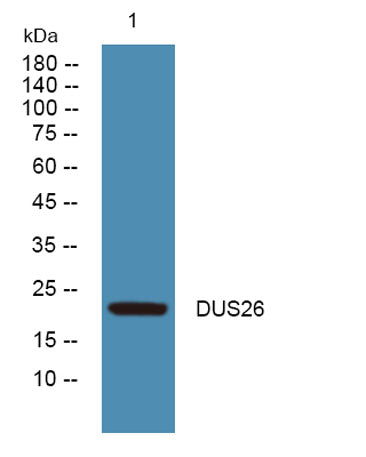
Observed_band(KD): 23kD
Human_gene_id: 78986
Human_swiss_prot_no: Q9BV47
Subcellular_location: Cytoplasm. Nucleus. Golgi apparatus.
Background: This gene encodes a member of the tyrosine phosphatase family of proteins and exhibits dual specificity by dephosphorylating tyrosine as well as serine and threonine residues. This gene has been described as both a tumor suppressor and an oncogene depending on the cellular context. This protein may regulate neuronal proliferation and has been implicated in the progression of glioblastoma through its ability to dephosphorylate the p53 tumor suppressor. Alternative splicing results in multiple transcript variants. [provided by RefSeq, Feb 2015],
Reactivity: Human;Mouse;Rat
Source: Rabbit
Dilution: WB 1:500-2000 ELISA 1:5000-20000
Immunogen: Synthesized peptide derived from human protein . at AA range: 130-210
Storage_stability: -20°C/1 year
Clonality: Polyclonal
Isotype: IgG
Concentration: 1 mg/ml
Observed_band(KD): 23kD
Human_gene_id: 78986
Human_swiss_prot_no: Q9BV47
Subcellular_location: Cytoplasm. Nucleus. Golgi apparatus.
Background: This gene encodes a member of the tyrosine phosphatase family of proteins and exhibits dual specificity by dephosphorylating tyrosine as well as serine and threonine residues. This gene has been described as both a tumor suppressor and an oncogene depending on the cellular context. This protein may regulate neuronal proliferation and has been implicated in the progression of glioblastoma through its ability to dephosphorylate the p53 tumor suppressor. Alternative splicing results in multiple transcript variants. [provided by RefSeq, Feb 2015],
Share