1
/
of
1
ELK Biotechnology
SKU:ES10520
CDC42 rabbit pAb
CDC42 rabbit pAb
Regular price
$250.00 USD
Regular price
Sale price
$250.00 USD
Unit price
/
per
Shipping calculated at checkout.
Couldn't load pickup availability
Applications: WB;ELISA
Reactivity: Human;Mouse;Rat
Source: Rabbit
Dilution: WB 1:500-2000 ELISA 1:5000-20000
Immunogen: Synthesized peptide derived from human protein . at AA range: 80-160
Storage_stability: -20°C/1 year
Clonality: Polyclonal
Isotype: IgG
Concentration: 1 mg/ml
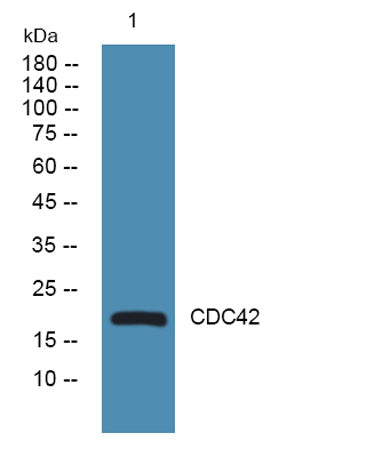
Observed_band(KD): 21kD
Human_gene_id: 998
Human_swiss_prot_no: P60953
Subcellular_location: Cell membrane ; Lipid-anchor ; Cytoplasmic side . Cytoplasm, cytoskeleton, microtubule organizing center, centrosome . Cytoplasm, cytoskeleton, spindle . Midbody . Cell projection, dendrite . Localizes to spindle during prometaphase cells. Moves to the central spindle as cells progressed through anaphase to telophase (PubMed:15642749). Localizes at the end of cytokinesis in the intercellular bridge formed between two daughter cells (PubMed:15642749). Its localization is regulated by the activities of guanine nucleotide exchange factor ECT2 and GTPase activating protein RACGAP1 (PubMed:15642749). Colocalizes with NEK6 in the centrosome (PubMed:20873783). In its active GTP-bound form localizes to the leading edge membrane of migrating dendritic cells (By similarity). .
Background: The protein encoded by this gene is a small GTPase of the Rho-subfamily, which regulates signaling pathways that control diverse cellular functions including cell morphology, migration, endocytosis and cell cycle progression. This protein is highly similar to Saccharomyces cerevisiae Cdc 42, and is able to complement the yeast cdc42-1 mutant. The product of oncogene Dbl was reported to specifically catalyze the dissociation of GDP from this protein. This protein could regulate actin polymerization through its direct binding to Neural Wiskott-Aldrich syndrome protein (N-WASP), which subsequently activates Arp2/3 complex. Alternative splicing of this gene results in multiple transcript variants. Pseudogenes of this gene have been identified on chromosomes 3, 4, 5, 7, 8 and 20. [provided by RefSeq, Apr 2013],
Reactivity: Human;Mouse;Rat
Source: Rabbit
Dilution: WB 1:500-2000 ELISA 1:5000-20000
Immunogen: Synthesized peptide derived from human protein . at AA range: 80-160
Storage_stability: -20°C/1 year
Clonality: Polyclonal
Isotype: IgG
Concentration: 1 mg/ml
Observed_band(KD): 21kD
Human_gene_id: 998
Human_swiss_prot_no: P60953
Subcellular_location: Cell membrane ; Lipid-anchor ; Cytoplasmic side . Cytoplasm, cytoskeleton, microtubule organizing center, centrosome . Cytoplasm, cytoskeleton, spindle . Midbody . Cell projection, dendrite . Localizes to spindle during prometaphase cells. Moves to the central spindle as cells progressed through anaphase to telophase (PubMed:15642749). Localizes at the end of cytokinesis in the intercellular bridge formed between two daughter cells (PubMed:15642749). Its localization is regulated by the activities of guanine nucleotide exchange factor ECT2 and GTPase activating protein RACGAP1 (PubMed:15642749). Colocalizes with NEK6 in the centrosome (PubMed:20873783). In its active GTP-bound form localizes to the leading edge membrane of migrating dendritic cells (By similarity). .
Background: The protein encoded by this gene is a small GTPase of the Rho-subfamily, which regulates signaling pathways that control diverse cellular functions including cell morphology, migration, endocytosis and cell cycle progression. This protein is highly similar to Saccharomyces cerevisiae Cdc 42, and is able to complement the yeast cdc42-1 mutant. The product of oncogene Dbl was reported to specifically catalyze the dissociation of GDP from this protein. This protein could regulate actin polymerization through its direct binding to Neural Wiskott-Aldrich syndrome protein (N-WASP), which subsequently activates Arp2/3 complex. Alternative splicing of this gene results in multiple transcript variants. Pseudogenes of this gene have been identified on chromosomes 3, 4, 5, 7, 8 and 20. [provided by RefSeq, Apr 2013],
Share