1
/
of
1
ELK Biotechnology
SKU:ES10138
RRAS2 rabbit pAb
RRAS2 rabbit pAb
Regular price
$250.00 USD
Regular price
Sale price
$250.00 USD
Unit price
/
per
Shipping calculated at checkout.
Couldn't load pickup availability
Applications: WB;ELISA
Reactivity: Human;Mouse
Source: Rabbit
Dilution: WB 1:500-2000 ELISA 1:5000-20000
Immunogen: Synthesized peptide derived from human protein . at AA range: 90-170
Storage_stability: -20°C/1 year
Clonality: Polyclonal
Isotype: IgG
Concentration: 1 mg/ml
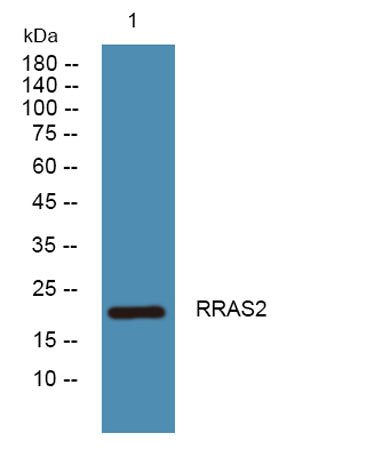
Observed_band(KD): 22kD
Human_gene_id: 22800
Human_swiss_prot_no: P62070
Subcellular_location: Cell membrane ; Lipid-anchor ; Cytoplasmic side. Golgi apparatus membrane ; Lipid-anchor .
Background: This gene encodes a member of the R-Ras subfamily of Ras-like small GTPases. The encoded protein associates with the plasma membrane and may function as a signal transducer. This protein may play an important role in activating signal transduction pathways that control cell proliferation. Mutations in this gene are associated with the growth of certain tumors. Pseudogenes of this gene are found on chromosomes 1 and 2. Alternate splicing results in multiple transcript variants. [provided by RefSeq, Apr 2010],
Reactivity: Human;Mouse
Source: Rabbit
Dilution: WB 1:500-2000 ELISA 1:5000-20000
Immunogen: Synthesized peptide derived from human protein . at AA range: 90-170
Storage_stability: -20°C/1 year
Clonality: Polyclonal
Isotype: IgG
Concentration: 1 mg/ml
Observed_band(KD): 22kD
Human_gene_id: 22800
Human_swiss_prot_no: P62070
Subcellular_location: Cell membrane ; Lipid-anchor ; Cytoplasmic side. Golgi apparatus membrane ; Lipid-anchor .
Background: This gene encodes a member of the R-Ras subfamily of Ras-like small GTPases. The encoded protein associates with the plasma membrane and may function as a signal transducer. This protein may play an important role in activating signal transduction pathways that control cell proliferation. Mutations in this gene are associated with the growth of certain tumors. Pseudogenes of this gene are found on chromosomes 1 and 2. Alternate splicing results in multiple transcript variants. [provided by RefSeq, Apr 2010],
Share