1
/
of
1
ELK Biotechnology
SKU:EM1083
IDE/Insulin Degrading Enzyme Mouse mAb
IDE/Insulin Degrading Enzyme Mouse mAb
Regular price
$250.00 USD
Regular price
Sale price
$250.00 USD
Unit price
/
per
Shipping calculated at checkout.
Couldn't load pickup availability
Applications: WB, IHC
Reactivity: Human
Source: Mouse
Dilution: WB 1:1,000 IHC 1:200
Immunogen: Synthetic Peptide
Storage_stability: PBS with 0.02% sodium azide and 50% glycerol pH 7.4. Store at -20°C. Avoid repeated freeze-thaw cycles.
Clonality: Monoclonal
Isotype: IgG1
Concentration: 1mg/mL
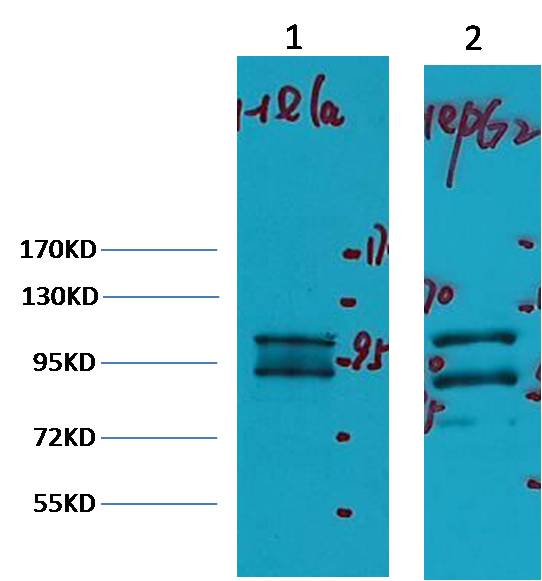
Observed_band(KD): 118kDa
Human_gene_id: 3416
Human_swiss_prot_no: P14735
Subcellular_location: Cell membrane, Cytoplasm, Membrane, Secreted
Other_name: Abeta degrading protease, insulin degrading enzyme, Insulin protease, Insulinase, INSULYSIN
Background: Insulin Degrading Enzyme (IDE) is a large zinc-binding protease of the M16A metalloprotease subfamily known to cleave multiple short polypeptides that vary considerably in sequence. IDE was first identified by its ability to degrade the B chain of the hormone insulin. This activity was observed over fifty years ago, though the enzyme specifically responsible for B chain cleavage was identified more recently.
Reactivity: Human
Source: Mouse
Dilution: WB 1:1,000 IHC 1:200
Immunogen: Synthetic Peptide
Storage_stability: PBS with 0.02% sodium azide and 50% glycerol pH 7.4. Store at -20°C. Avoid repeated freeze-thaw cycles.
Clonality: Monoclonal
Isotype: IgG1
Concentration: 1mg/mL
Observed_band(KD): 118kDa
Human_gene_id: 3416
Human_swiss_prot_no: P14735
Subcellular_location: Cell membrane, Cytoplasm, Membrane, Secreted
Other_name: Abeta degrading protease, insulin degrading enzyme, Insulin protease, Insulinase, INSULYSIN
Background: Insulin Degrading Enzyme (IDE) is a large zinc-binding protease of the M16A metalloprotease subfamily known to cleave multiple short polypeptides that vary considerably in sequence. IDE was first identified by its ability to degrade the B chain of the hormone insulin. This activity was observed over fifty years ago, though the enzyme specifically responsible for B chain cleavage was identified more recently.
Share