ABCbiolab
SKU:ABCCS00291
EGFR Antibody
EGFR Antibody
Couldn't load pickup availability
Size
100ul
Clone Number
9F10
Aliases
Epidermal growth factor receptor (EC 2.7.10.1) (Proto-oncogene c-ErbB-1) (Receptor tyrosine-protein kinase erbB-1), EGFR, ERBB ERBB1 HER1
Immunogen Species
Homo sapiens (Human)
UniProt ID
P00533
Immunogen
A synthesized peptide derived from human EGFR?ErbB 1?
Raised in
Species Reactivity
Human
Tested Applications
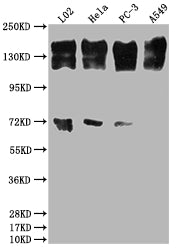
ELISA, WB, IHC, IF, FC; Recommended dilution: WB:1:500-1:5000, IHC:1:50-1:200, IF:1:20-1:200, FC:1:20-1:200
Background
Receptor tyrosine kinase binding ligands of the EGF family and activating several signaling cascades to convert extracellular cues into appropriate cellular responses. Known ligands include EGF, TGFA/TGF-alpha, amphiregulin, epigen/EPGN, BTC/betacellulin, epiregulin/EREG and HBEGF/heparin-binding EGF. Ligand binding triggers receptor homo- and/or heterodimerization and autophosphorylation on key cytoplasmic residues. The phosphorylated receptor recruits adapter proteins like GRB2 which in turn activates complex downstream signaling cascades. Activates at least 4 major downstream signaling cascades including the RAS-RAF-MEK-ERK, PI3 kinase-AKT, PLCgamma-PKC and STATs modules. May also activate the NF-kappa-B signaling cascade. Also directly phosphorylates other proteins like RGS16, activating its GTPase activity and probably coupling the EGF receptor signaling to the G protein-coupled receptor signaling. Also phosphorylates MUC1 and increases its interaction with SRC and CTNNB1/beta-catenin. Plays a role in enhancing learning and memory performance (By similarity).
Clonality
Monoclonal
Isotype
Rabbit IgG
Purification Method
Affinity-chromatography
Conjugate
Non-conjugated
Buffer
Rabbit IgG in phosphate buffered saline, pH 7.4, 150mM NaCl, 0.02% sodium azide and 50% glycerol.
Form
Liquid
Stroage
Upon receipt, store at -20°C or -80°C. Avoid repeated freeze.
Target Names
EGFR
Research Areas
Cancer; Signal transduction
Share